Category: How-To

  • Free STEM Bell Ringers and STEM Sub Plans

    Free STEM Bell Ringers and STEM Sub Plans

    Your STEM activity has come to an end and another class is waiting outside your door. There are zero minutes to prep. How do you buy yourself a few moments to clear the chaos and get settled?

    Just as importantly — how do you do it without wasting precious minutes of class?

    I’ve got you – STEM Bell Ringers that focus on getting students settled and in the right head space for STEM!

    Better yet —

    • They’re no prep. ⏰
    • They require no materials beyond paper & pencil (not even that if you have 1:1 tech) 📝
    • They focus a LOT on developing creativity, critical thinking and curiosity. 🎯
    • They’re versatile — you can easily use these as STEM bell ringers, for STEM sub plans, or for STEM centers! 🙌
    • I’m giving you two weeks to try them out for free 🥰


    Take a Peek Inside the STEM Bell-Ringer / STEM Sub Plans Freebie

    Inside the freebie, you’ll find two weeks of STEM Bell Ringers. Each week contains five activities + a choice board:


    STEM Bell Ringer / STEM Sub Plan Activity 1: STEM Improv

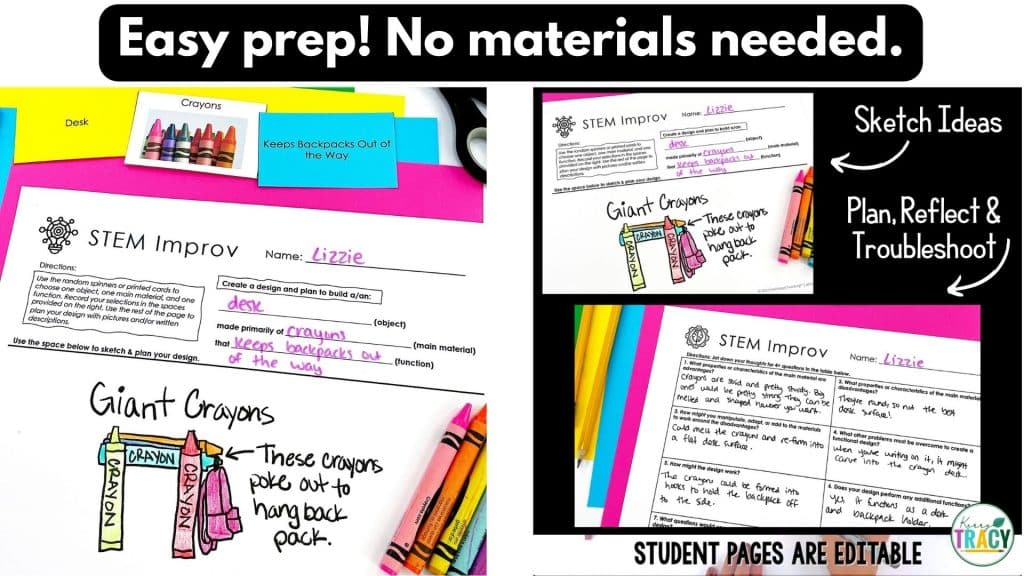
    You’re getting the full print & paperless resource here. Students spin a wheel to randomly select an object, a material, and a function. You can see an example in the picture below: Design a desk, made of crayons, that keeps backpacks out of the way.

    There are 336 possible combinations when students, so you can use this over and over again!


    STEM Bell Ringer / STEM Sub Plan Activity 2: See-Notice / Think-Wonder

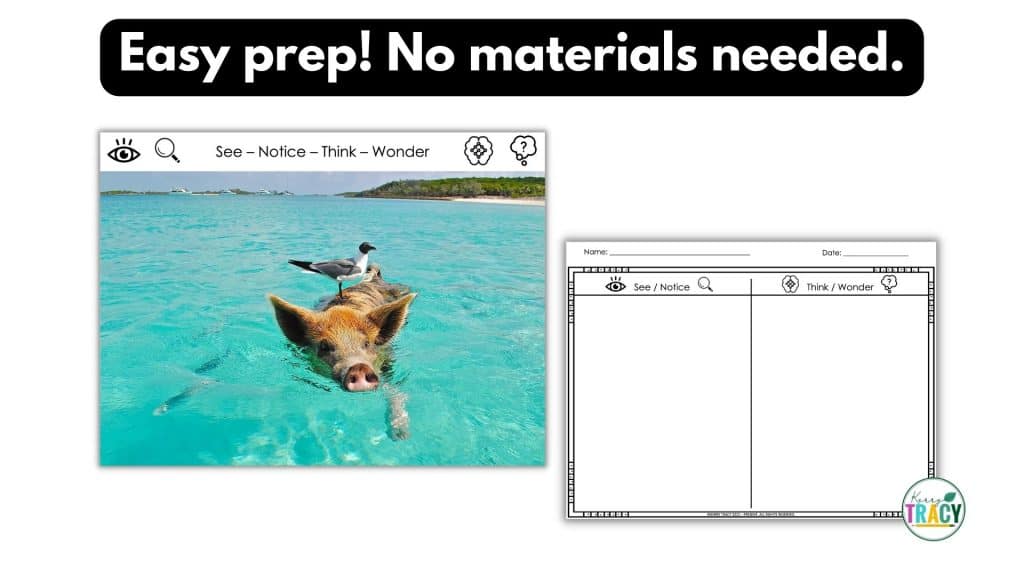
    See-Notice-Think-Wonder is a simple, but powerful exercise in developing observation skills, critical thinking and curiosity. This can be done with physical objects or photographs. Let students examine the image for ~3-5 minutes and let their minds wander.

    On one side of the handout, students list all the things they see or notice about the image. This is the “light-lifting” side. They’re making observations, noticing patterns, etc. On the think/wonder side, students engage their brains more. They make connections to things they already know and draw conclusions and list as many questions as they can. (More details are available in the video at the bottom of the post.)


    STEM Bell Ringer / STEM Sub Plan Activity 3: Would You Rather STEM

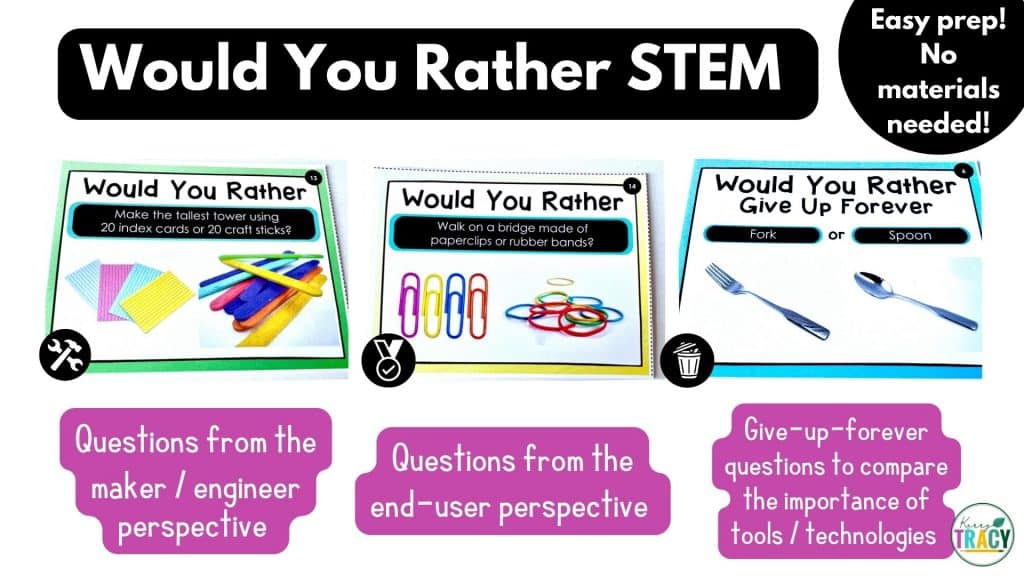
    I’ve set my Would You Rather STEM questions into three categories for the first set. (I may add other categories in the future). The three question types ask students to think of themselves as the maker in the scenario, the end-user, or to consider the importance of various objects and technologies and decide which one to give up forever. Your freebie samples include one from the maker and one from the end-user perspective.

    The freebie folder contains one example for each week. The ones shown in the image are from later weeks in the series and are not included. They are shown here as examples.


    STEM Bell Ringer / STEM Sub Plan Activity 4: Analyze This vs. That

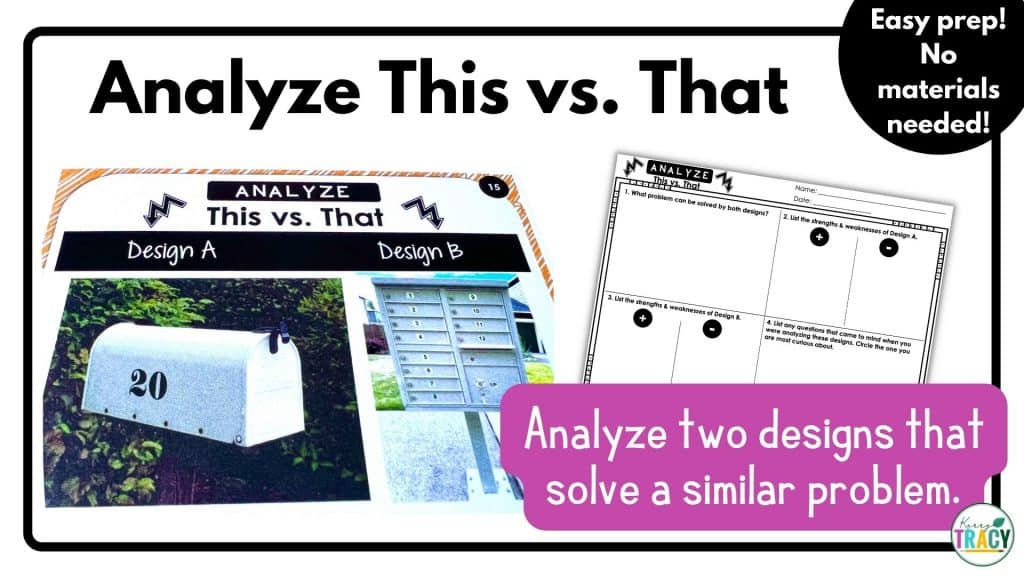
    In this activity, we take two everyday objects that solve roughly the same problem. Students identify the problem being solved, the strengths & weaknesses of both designs, and list any questions they have. This simple cards are set up to be completed quickly, which makes them ideal as STEM bell ringers.

    However, if you want more in-depth questions or options to compare/contrast three or four designs or go deeper on analyzing one or two designs, there are two options:

    Check out Real-World Design Analysis for handout templates and/or wait a smidge for the 3-4 set of Analyze This vs. That to come out. It’s coming soon!

    The freebie folder contains one example for each week. The one shown in the image is from a later week in the series and is not included. It’s shown here as an example.


    STEM Bell Ringer / STEM Sub Plan Activity 5: 8 Ways to Use

    Grab any everyday object and ask students to come up with 8 ways to use it. You can do this with physical objects or photographs. You’ll get two example slides in your freebie folder. One key to this — encourage students to vary the verb they use to stretch their minds!

    The freebie folder contains one example for each week.


    Quick Tips:

    In the video below, I go over tips on how to use these activities and a few others to enhance you 4 C’s of Engineering lessons.


    Pin Me

    Use these free STEM creativity and critical thinking activities as STEM bell ringers, for STEM sub plans or STEM centers.
  • How to Teach the 4 Cs of Engineering – Fast & Free

    How to Teach the 4 Cs of Engineering – Fast & Free

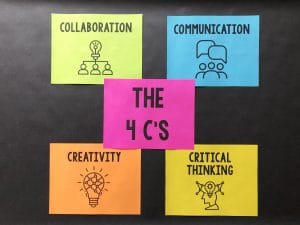
    You know the 4 C’s of engineering are creativity, critical thinking, collaboration, and communication. Your students know it too. But getting students to identify the 4 C’s and getting them to demonstrate the 4 C’s are two very, VERY different things! A vast chasm sometimes exists between the two.

    I know you know the pain I’m talking about. 😂

    So how to we build students a bridge to walk from knowing the 4 C’s of engineering and embodying the 4 C’s of engineering?

    Real-Talk News — We have to teach what these skills look and sound like and we have to practice them often.

    Better News — I have LOTS of ways to teach creativity, critical thinking, collaboration, and communication for you today!

    Best News – Everything is very low prep / no prep, fast & free & many ideas can be repeated quite a lot!

    Bonus News — I’m throwing in a 5th C — Curiosity!


    I go over everything in the video below, or you can read on if you prefer. What’s the difference? The main ideas are the same in both. However, the post is more of a condensed outline. In the video, I give more tips, show more examples, talk about troubleshooting, answer questions, etc. 😊


    How to Teach Creativity

    First off, we need to create an environment that encourages creativity. This means we need to clear a little bit of time to let the brain breathe a bit. I like to play focus music, usually classical or other instrumental music while students work on some of these activities.

    Creativity Free Idea #1 – STEM Improv

    In STEM Improv, students choose at random a material, object and function. The materials are unconventional (any Project Runway fans in the house?🙌). When combined with the random objects and functions, students stretch their minds and imaginations to plan a design. Because they aren’t actually building the designs, the possibilities are endless. You can do this in just 5 minutes, or you can include the reflection questions and stretch it to 10-15. There are extension ideas too if you want to keep going.
     

    Creativity Free Idea #2 – 8 Ways to Use …

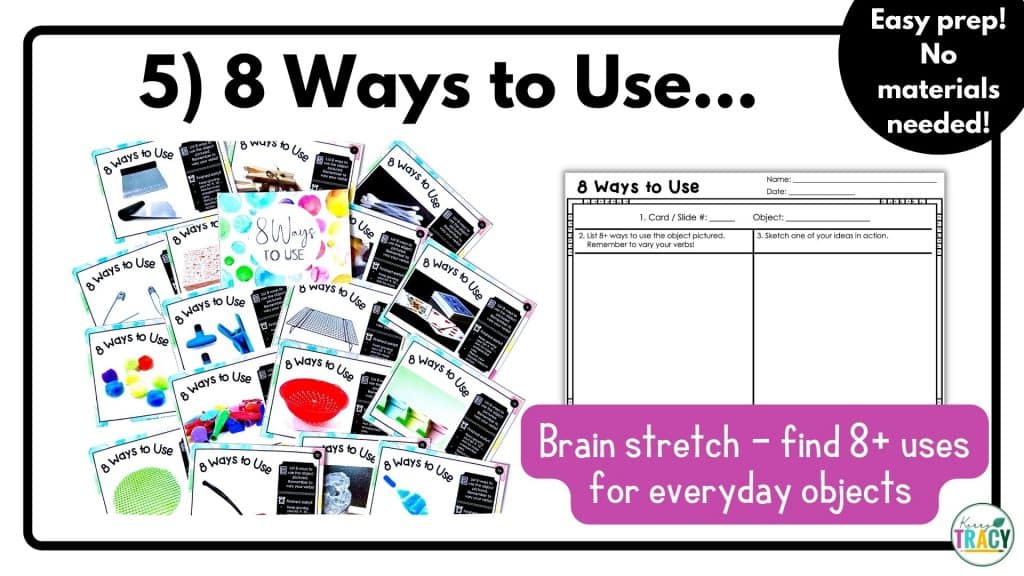
    Grab any everyday object and ask students to come up with 8 ways to use it. You can do this with physical objects or photographs. I’ve included some examples in the 2 weeks of bellringers in your freebie folder. I also shared some ideas in the video. One key to this — encourage students to vary the verb they use to stretch their minds!
     

    Creativity Free Idea #3 – Partial Drawings

    Grab this freebie from Momgineer! Such a simple and easy thing to do. In addition to pre-made partial drawings like these, you can also make your own. Just go into PowerPoint or Google Slides and make a page full of circles, triangles, squares, etc. and have students turn those shapes into various objects. For example, someone might turn a circle into a basketball, a soccer ball, a Petri dish, etc. Fast, fun & easy — my favorite!

    Creativity Quick Tip

    Use a 4 Cs Rubric to review creativity expectations before every STEM Challenge. There’s one in your freebie folder! ❤️


    How to Teach Critical Thinking

    OK, this is the big one, right? How to we help students to think critically? What do we even mean by that? For me, I’m looking for students to be engaged with the content, to make connections, ask questions, discuss, debate, be skeptical, analyze, compare & contrast, use logic & reason … basically, all the things!

    Sounds pretty, but again, there’s a chasm between knowing and doing & we need to bridge the gap!


    Critical Thinking Free Idea #1 – Would You Rather STEM Scenarios

    This is the easiest place to start. It’s a great bell-ringer. I’ve set my Would You Rather questions into three categories for the first set. (I may add other categories in the future). The three question types ask students to think of themselves as the maker in the scenario, the end-user, or to consider the importance of various objects and technologies and decide which one to give up forever. You’ll find some examples in the freebie folder, and I pictured some below too.
    Critical Thinking Free Idea #2 – Analyze This vs. That

    Take two everyday objects or photos of two designs that solve roughly the same problem. Have students identify the problem being solved, the strengths & weaknesses of the designs, and any questions they have. I’ve set up these simple cards to complete the activity as a bell ringer. If you want more in-depth questions or options to compare/contrast three or four designs or go deeper on analyzing one or two designs, there are two options.

    Check out Real-World Design Analysis for handout templates and/or wait a smidge for the 3-4 set of Analyze This vs. That to come out. It’s coming soon!
    Critical Thinking Free Idea #3 – STEM Improv (again)

    The second student page guides students through a series of questions to consider potential problems in the materials & design, ideal customers, questions they need answered, etc.


    Critical Thinking Quick Tip

    Use a 4 Cs Rubric to review critical thinking expectations before every STEM Challenge. There’s one in the freebie folder. 💜


    How to Teach Collaboration

    Admission — I used to tell students they needed to collaborate without really defining it and then get frustrated when they didn’t meet my expectations: a classic tell vs. teach moment! 😂

    So first, let’s make sure everyone is on the same page.

    Collaboration Free Idea #1 – Mini Lesson

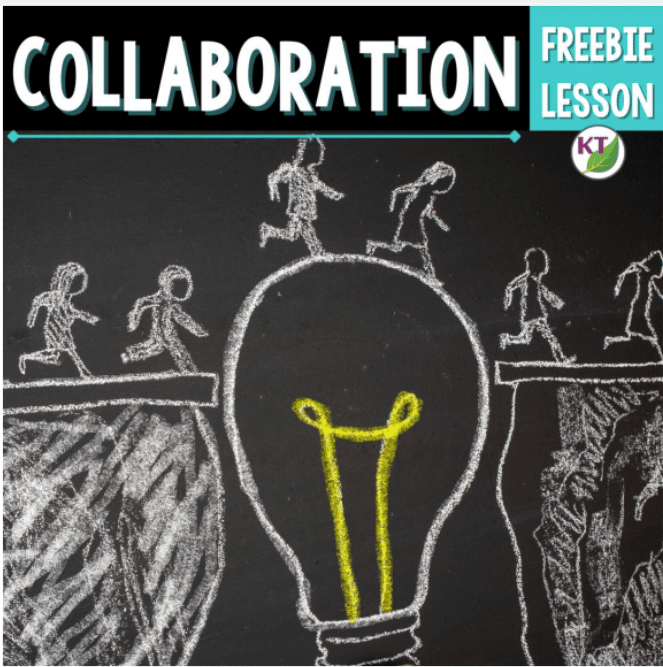
    In this activity, students define what collaboration is, what it looks like, what it sounds like, and how to troubleshoot when collaborations don’t go according to plan.
    Collaboration Free Idea #2 – Build Challenge

    Choose a simple build challenge, like a card tower. Before doing the challenge, give students the 4 C’s of Engineering rubric (there’s one in the folder). Tell them their main focus will be on collaboration. That means, when they finish the activity, you’ll all look at the towers, but the focus of your discussion will be on examples of collaboration — good, bad & ugly.

    Have them rate themselves on the rubric. Ask for specific examples where they incorporated and considered each other’s ideas, where they felt heard & where they didn’t (try to get students to tell what behaviors and words felt affirming or dismissive).

    Try not to get annoyed when they don’t collaborate well. Just give them the time to analyze & discuss and think about ways to do it better next time. Knowing how to collaborate can all go up in the air when faced with a team challenge, the stress of time limits,  personality conflicts, etc. Taking the time to reflect on the 4 C’s of engineering after using them in context is so helpful!

    Collaboration Quick Tip:

    During STEM Challenge activities, if students are having trouble collaborating, refer back to the rubric & mini lesson, of course. In addition, it’s helpful to sometimes have students each create a plan/design on their own. Then group them up and require at least one idea from each team member is included in a new group design.


    How to Teach Communication

    Communication Free Idea #1 – Speak, Listen, Draw

    Love this one – partner students up. Student 1 has a card with a drawing and gives directions to Student 2 to draw the picture. There are sample cards in the folder, and you can even have students create their own. I usually do this as an oral activity, but it’s also a great writing activity. Have students plan & write out their directions one day. Maybe challenge them to create the “perfect” directions in the fewest amount of words or sentences and then try it out on a subsequent day.

    Communication Free Idea #2 – STEM Activity Exchange Program

    I got this idea from a fabulous teacher in a training I did in Auburn, WA. I wish I had written down her name, so I could credit her properly.

    When doing any STEM Challenge, every few minutes, select one student from each group to shift to another group. Their new group must get them up to speed on their designs and incorporate them into their team. This can also help with collaboration issues. Take that dominant child out of their team and shift them to a new team. It’s pretty tough to walk into a new team with an idea in progress and convince them to chuck it all to go with your ideas!


    Communication Free Idea #3 – STEM Activity in Silence

    I’m pretty sure this was the same teacher’s idea too — have students do a simple challenge, like the card tower, in complete silence. They must communicate with gestures and writing only.


    Communication Quick Tip

    Use that 4 Cs Rubric to review communication expectations before every STEM Challenge.


    How to Teach Curiosity

    Curiosity, like creativity, requires time, space & quiet for the brain to breathe.


    Curiosity Free Idea #1 – See, Notice, Think, Wonder

    Bonus – this STEM activity is actually critical thinking too. In See-Notice-Think-Wonder, either bring in an object or photograph for students to examine and let their minds wander. It’s great if this object is something unusual or interesting to begin with, but over time, you can challenge students with things that are more ordinary.

    Have students fold their papers in half. I prefer to have the paper in landscape, but you do you! On one side students list all the things they see or notice about the image. This is the “light-lifting” side. They’re making observations, noticing patterns, etc. On the think/wonder side, students engage their brains more. They make connections to things they already know and draw conclusions and list as many questions as they can. (More details are available in the video at the top of the post.)

    I’ve included examples of See, Notice, Think, Wonder in your folder in both weeks of the STEM Bell Ringers.
    Curiosity Free Idea #2 – Question Competitions

    Put students in groups and task them with coming up with as many questions as possible in a set amount of time. You’ll notice as you go through many of the freebies, getting students to generate questions is included quite a lot. It turns on a different part of the brain when we’re asked to generate questions!


    Curiosity Tip

    Follow-through — you don’t have to follow-up on every single question students come up with. It’s ok to practice generating questions for its own sake. However, it’s far more powerful to give students time to follow up with research on their curiosities.

    For example, if you try those two weeks of STEM Bell Ringers in your folder, several days each week asks them to generate questions and circle the ones they’re most interested in answering. Once every week or so, give them time to research one or more of their circled questions. You’ll notice this is an option on the choice board included.


    When Teaching the 4 C’s of Engineering – Patience, Environment & Culture are Key!

    Remember to be patient as our students build these skills. Many of them don’t have strong 4 Cs muscles — and that’s probably why you’re here reading this!

    Just like a sedentary person can’t lift 200 lb. weights over their head in their first visits back to the gym, we needn’t be discouraged with a slow start from students as we begin these exercises. Some kids will shine and others will struggle, but keep at it.

    Finally, make time for students to share their questions, ideas and designs from all of these activities. They’ll learn from each other and the opportunity to impress and entertain each other encourages engagement and buy-in.


    Related Blog Posts


    Related Resources


    PIN ME
  • For Parents New to Homeschool

    For Parents New to Homeschool

    These last few weeks have been trying for all of us. Teachers have been thrust into strange new territory with distance learning, and parents received an unexpected new job of homeschool teacher.


    I’m hoping to help both groups navigate the waters just a little bit easier, but I’ll be honest, this is new territory for me too. Watch the video for more details on my plan.


    So parents, if you want to be your child’s facilitator for STEM Challenges, here are the links that will help you:

    Feel-Good Teaching on YouTube

    You’ll find 52 STEM Challenge video walk-throughs here. Remember, these videos are for you as the facilitator. Don’t show them to your kids. It will inhibit their problem-solving and creative process.


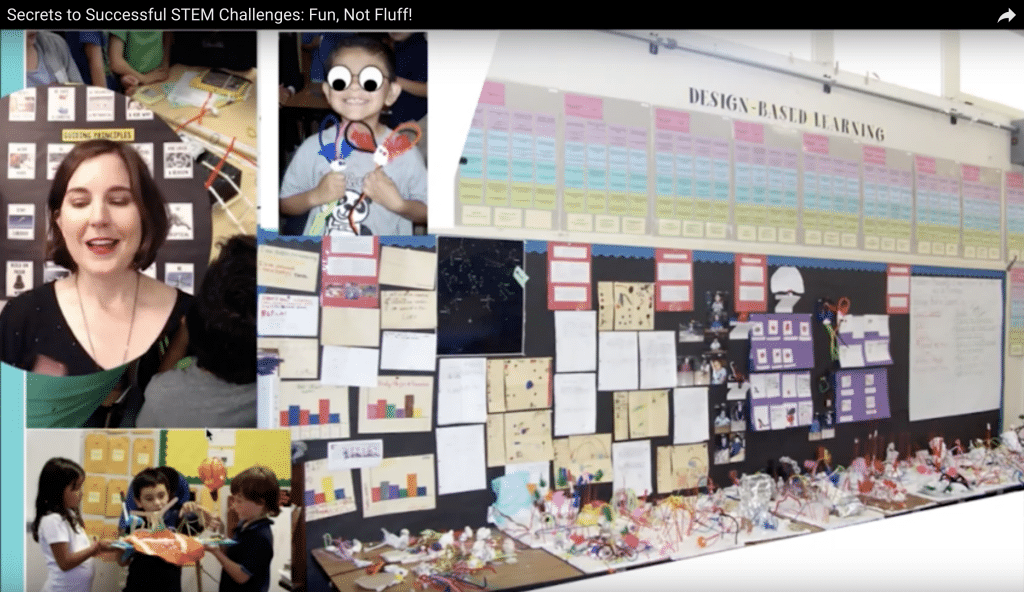
    And don’t forget to check out Getting Started with STEM Challenges playlist and/or Secrets to Successful STEM Challenges training.


    Universal STEM Challenge Templates

    These templates and editable and will help you set up any challenge and guide your kids to record, reflect, and analyze.


    Take the Personality Quiz for Guidance & Freebies

    I made this quiz to determine where teachers were in their STEM Challenge understanding. Some of the questions may not apply well to you, but most still will. At the end of the quiz, you’ll get some links and directions for what will help you. You’ll also get an option to have me send five days of STEM Challenge freebies right to your inbox.


    Or, if you’d rather have someone else (me!) guide you child …

    Get Notifications for Simple STEM at Home

    You never planned to be a homeschool teacher. I get it, and I’m going to do my best to help! I’ll send you emails to notify you when new videos and assignments are ready for your kids. I’ll be focusing on making this work for the widest range possible of elementary and middle school students, giving them options to make the work the right level of difficulty.

    Videos will go up each weekday at 10:00 a.m. Pacific. Occasionally, we may add videos as needed. Out first week starts Monday, March 23.

    Videos will be shared on a new YouTube channel (link will be shared as soon as it’s ready). Assignments will be shared using Google Drive.

  • Teaching Students to Persevere During STEM Challenges

    Teaching Students to Persevere During STEM Challenges

    Be honest — have you ever been profoundly irritated or disappointed in how quickly your students give up when things get tough during a STEM Challenge? Have you lamented their seeming inability to persevere and be resilient?


    Been there. Done that!


    You know what? Neither is particularly helpful in solving the problem! I’m guessing you knew that already.


    If you’ve been on this site before, you know I’m always talking about truly challenging your students and limiting your use of “simple” STEM. This means you are very likely to run into this problem of students shutting down and giving up.


    Here’s what I’ve realized over time:

    Perseverance and determination are skills to be taught and practiced just the same as adding fractions with unlike denominators.


    When you introduce adding fractions, you don’t just tell your students to add them up. And when they struggle or fail, you don’t keep telling them, “Just keep adding them up!” You show them how, right? You go through multiple methods to getting the job done. You find ways for them to practice and turn the abstract into something more concrete.


    Yet, we often use the ineffective “tell them” approach with softer skills like perseverance. We say:

    “Keep at it!”

    Don’t give up!”

    “Just keep trying!”

    “Use your growth mindset!”

    This is as useless as, “Just do your best to add those fractions, pal. You’ll figure it out eventually.”


    And this is where our misstep is with many growth mindset skills: we talk the talk, but we don’t give students tools they need to understand how to walk the walk.


    We need to do a few things to help students understand an practice what it looks like to persevere.

    1. Recognize the Opportunity of Teachable Moments

    I have been guilty in the past of treating student shutdown as an obstacle to the content standards I’m trying to teach. I’ve been agitated and fretted that we don’t have time for this! I’ve barked unhelpful phrases like, “You can’t just give up when something gets hard. Keep at it!”


    What I’ve learned is that we need to treat life skills like perseverance with at least the same respect as teaching any content standard. If we can teach our students to keep working when things get hard, it will pay dividends in all subjects, all year long (and beyond).


    2. Hold a Class Discussion About What Causes People to Want to Give Up

    When students are ready to give up on a challenge, they’re usually at peak-frustration level. There’s often a lot of emotion going on. This is one reason our encouraging words often fall flat.

    Take time to explore what is happening and what causes people to want to give up. Be curious and nonjudgmental throughout the discussion. Help students make sense of what’s going on in their minds when they want to give up.


    3. Create a Procedure with Action Steps

    What does it look like to persevere? How do we make the switch from emotional shutdown to positive action? Create a simple, doable procedure with your students to help them understand what positive action steps they can take the next time they’d rather just give up.

    Understanding what actions would be helpful, and then actually taking those actions is the piece we often leave for our students to figure out on their own. We wouldn’t leave them in the dark with fractions; we shouldn’t do it with perseverance either.


    Need some direction for leading a productive discussion on perseverance?

    Want to know exactly what questions and follow-up questions to ask during the whole-class discussion?

    Want an editable copy of the “Getting Un-Stuck” procedure poster I use?

    Check out this 15 minute training that comes with the discussion notes and procedure poster:


    Or grab the whole Growth Mindset in STEM Challenges Bundle:


    PIN ME!

  • 3 Mistakes Teachers Make with STEM Challenges and How to Fix it Fast

    3 Mistakes Teachers Make with STEM Challenges and How to Fix it Fast

    I’ll be the first to admit that my first few STEM Challenges were a bit of a disaster.

    Chaotic, constantly running out of time, high frustration levels, and so many missed opportunities with academics and social skills …OOF! It’s really hard to think about now. 🤦‍♀️

    However, over time, I created a process that made STEM Challenges the biggest game-changer in my classroom for student achievement, developing social-emotional skills, and ENJOYING the learning process. Win-Win-Win!!!

    …And personally, STEM Challenges made me fall back in love with teaching again. I was in a place where I REALLY needed that!

    But my road there was bumpier than it needs to be for you.


    P.S. If you liked this topic and want to explore it even more, I’m hosting a free webinar in just a few days!

    “STEM Challenges: From Fluff to Fire” will teach you 3 Keys to STEM Challenges that Create Gritty, Future-Proof Kids (not just a cute craft and giant mess).

    If you want to bypass the chaos, frustration, and white-knuckle hodge-podge teaching, you won’t want to miss it!


    Learn more & Grab your free spot! 


    PIN ME

  • Which STEM Challenge Materials are Best?

    Which STEM Challenge Materials are Best?

    One of the most frequently asked questions I get is, “What STEM Challenge materials should I have in my classroom?”


    While most STEM Challenges come with a recommended materials list, you’ll often have plenty of flexibility. You can easily swap out some materials for others and add and delete materials as you see fit.


    When you’re just starting out, you might not feel confident in your ability to make those decisions just yet. You might feel like you want to follow the suggestions to a T, and that’s OK too! You do you!


    via GIPHY


    So what’s good to have on hand, in general?


    My best advice is to stock up on materials that are cheap & malleable! 


    Here’s a video I made about it ages ago. I’ve since gotten a bit better at making videos, I hope you agree! This one might be fun to watch just to mock me about it.


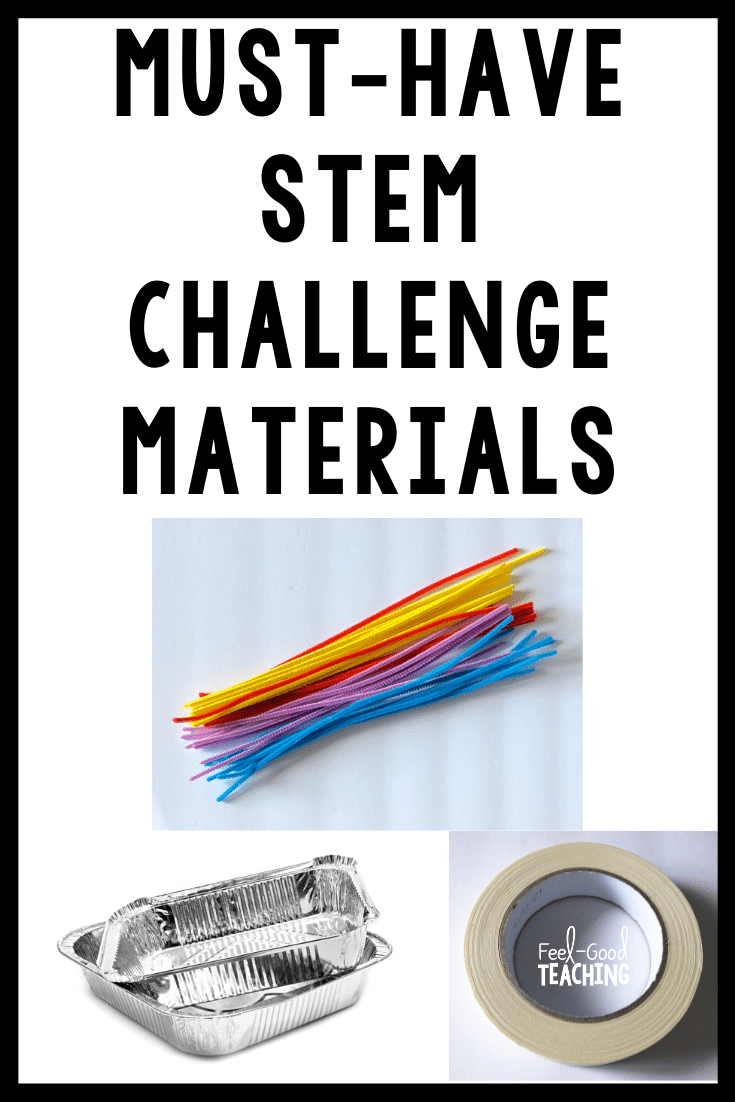
    My top suggestions are pipe cleaners, foil sheets, soft cardboard, and masking tape. The reason it’s so important to use these types of materials is that students can mold them easily, which results in more creative, different, and innovative designs.


    Rigid materials are not easy to manipulate. Using too many rigid materials results in many more look-alike designs, because there’s only so much that can be done with them. That doesn’t mean you don’t ever want to use things like popsicle sticks, hard plastics and strong cardboard. Sometimes those things are called for, but as often as you can get away from using them, I recommend it.


    Ask yourself when you’re planning the materials for a challenge, do the students really need corrugated cardboard or wooden sticks here, or could I give them a cereal box and require them to build up the strength themselves through folds, layers, and other methods? Whenever you can have students engineer, let them! Don’t give them too many shortcuts — it’s a STEM Challenge, not a STEM easy!


    Here’s a list of my favorite materials to stock up on and always have on hand. It includes malleable materials I’ve mentioned and a whole bunch of other practical materials and tools I LOVE! (Note: this is an affiliate page, which means I get a few cents to support my pipe cleaner habit if you make a purchase.)


    What are your favorite STEM Challenge materials? Let me know in the comments!


    Want to know where the best materials deals are? Here’s what I learned when I went looking:

    The freebies mentioned in this video can be found here.


    PIN ME

    One of the most frequently asked questions I get is, "What STEM Challenge materials should I have in my classroom?"

  • You Do Have the Time to Do STEM Challenges Right

    You Do Have the Time to Do STEM Challenges Right

    In the last year or so,  I’ve seen an increasing number of requests in social media groups I’m part of for STEM Challenges that can be done in 5 minutes.

    5 minutes?!


    via GIPHY


    How challenging can anything be that can be accomplished in just 5 minutes?


    Five minutes isn’t even enough time for a proper build, let alone all the other steps of the Engineering Design Process / STEM Challenge Cycle that make the challenge worth doing in the first place.


    We dedicate endless instructional minutes to reading and math to the detriment of everything else. I’m honestly getting tired of defending the need for a well-rounded, full-bodied education. Besides the fact that the ELA/Math stranglehold isn’t working, it’s short-sighted. We aren’t preparing students for success in the 21st century when we ignore science, history, art, music, PE, character education, and on and on and on.


    I recently wrote about why “simple” STEM is a problem, so I won’t repeat those arguments here. It’s sufficient to say that “simple” STEM is to STEM Challenges what this dog’s routine is to exercise!


    via GIPHY


    Today, let’s assume you agree or are at least open to the idea that simple STEM isn’t remotely the same thing as actual STEM Challenges.

    We’ll focus on problem-solving our time issues to allow for deeper, better STEM Challenges that prepare students for the 21st century — even if that means we end up doing fewer of them throughout the year. Fewer can be better!


    Step 1: Reality Check

    Take a look at your schedule. The minutes you’re given have largely been imposed upon you. What you choose to do from there affords far more choice than we might initially believe.


    Would you reasonably say any of the following?

    I want to make world-class pasta sauce from scratch, but I only have 15 minutes.

    I need someone to paint my house impeccably, top-to-bottom, in the next 2 hours.

    I’m going to need a full glamorous makeover for my high school reunion, and I also have just 30 minutes to get ready.

    I really need that heart surgery, but I really only have an hour to spare for it. Can anyone recommend a heart surgeon who can get it done in an hour?


    via GIPHY


    It is similarly absurd to expect simple, 5-minute “challenges” to deliver on the benefits of a well-conducted STEM Challenge. You either adjust your expectations of the outcome, or you find the time to get the outcome you desire.


    I am not willing to adjust my expected student outcomes. So, before we go any further, we should talk about priorities and get on the same page there.


    Step 2: Define Priorities

    There are a lot of great reasons why to do STEM Challenges with your students.

    Here’s my short list:

    • Prepare students with the skills needed to have successful, happy lives in the 21st century.
      • Get students actively engaged in relevant, challenging problem-solving
      • Have students practice the 4 C’s of Engineering (collaboration, communication, creativity and critical thinking)
      • Work on a host of soft skills around growth mindset, productive failure, resilience, determination, etc.
    • Connect as many content standards as possible


    In addition to these goals, I recently put together two questions as part of a STEM Challenge Teacher Personality Quiz that really call into sharp focus your priorities and how well they align with your actions:


    At the end of the day, which student goal are you working toward more than any other?

    and

    If your class was a carnival ride, how will your students remember it?


    Reflecting on these answers and what actually goes on most days in the classroom can be sobering.


    It makes me regretful knowing that for a number of years, my schedule often didn’t reflect my priorities. What I realized over time is with some creative planning and connecting multiple subject standards, I could match up important goals with what I was dedicating instructional minutes to in the classroom.


    It can be done!


    Step 3: Make the Time


    A good STEM Challenge is probably going to take between 60-90 minutes. You can split that up over a number of days, but if you want students to not only plan & build, but to also reflect and analyze and make meaningful connections (and you should want those things … a lot) you must dedicate time to these areas.


    My priorities listed in the section above can’t be accomplished with “simple” STEM. If I believe those priorities are … well … priorities, I have to make the time and space necessary to accomplish student goals.


    Right now, you might be thinking, “Of course I’d love to have students dive deeper and discuss, reflect, analyze, and extend, but I just don’t have the time!”


    I’m going to challenge you to think creatively about how you can fit in those crucial steps of the STEM Challenge Cycle. If you’re self-contained, there is no doubt you can make this work. None! Nada! There are so many options!


    If you are an elective or single-subject teacher, it can be trickier for sure, but it can be done.


    I give several examples of making the full cycle work with short class periods in two videos below.


    One example of an elective schedule I’ve heard about since making the videos above is a STEM elective class where the students are seen daily, but each day is dedicated to a different STEM topic: coding, robotics, STEM Challenge, etc. All topics are covered each week.


    Monday – Thursday, the class lasts about 45 minutes. On Friday, the students are seen for 20 minutes.


    The original schedule placed STEM Challenges on the Friday of each week, so the teacher had 20 minutes to work with.


    I’d recommend trying something different in order to gain more from STEM Challenges. I’d consider dedicating an entire week to a STEM Challenge every 4-8 weeks. An entire week would give students time to make it all the way through the cycle with extensions and likely a second opportunity to build. It would also open up a far wider range of STEM Challenges to try. More complex challenges can’t even be built by students in just 20 minutes.


    I might similarly focus on the other STEM topics (robotics, coding, etc.) in a similar fashion, with full-week projects that are cycled through less often. You might even mix things up with a deep dive week followed by shorter activities in each area (like the original schedule) to serve as sort of palate cleaner in between. Choosing between breadth and depth requires some balance and some experimentation to find the best fit!


    I know there are so many different schedule issues out there. If nothing suggested here solves your problem, please reach out and let me know what your setup is in the comments.

    I’m happy to try to help you find a way to make deeper STEM Challenges work with your reality!


    PIN ME!


    You probably have more time than you think to make a proper STEM Challenge work with your schedule. Check out this blog post to see some sample schedules for making STEM Challenges work with short class periods.

  • Science-Themed Crafts Are Not STEM Challenges

    Science-Themed Crafts Are Not STEM Challenges

    I’ve said it before, and I’ll say it again: I enjoy crafts. I mean no disrespect to craft-lovers, but  science-themed crafts are NOT STEM Challenges.


    Period.

    Hard stop.

    End of story.


    You know how some topics make you next-level insane? Those things you try to play it cool about so you seem like a calm, rational, totally reasonable human-being on the outside, even though you’re hulking out inside?

    This is that thing for me. When I see teachers posting pictures of crafts and describing it as a “great STEM Challenge”, it makes me upset. I’m talking about an embarrassing, unnatural degree of anger. Sometimes I feel like I’m screaming into the void, for reals! 🤣


    via GIPHY

    Why is There Confusion About STEM Challenges vs. Crafts?

    It makes perfect sense that teachers – and everyone else – would be confused about what constitutes a STEM Challenge vs. a craft. There are a LOT of mislabeled activities floating around on the Internet — so, so many!


    Some are crafts, some are hands-on activities, and some are actual challenges.


    There’s no governing body regulating what people call their resources and lessons. I can call myself Miss America any time I want, but that doesn’t make me a beauty queen!


    Just because it’s a hand-on activity and it involves a science topic, that just doesn’t make it a STEM Challenge.


    via GIPHY


    Hey Kerry, Why Are You So Salty About This?

    I worry that teachers are hearing about all the amazing benefits of what STEM Challenges can do to help students with soft skills (like collaboration, communication and growth mindset) and content standards. Naturally, they’re excited to try it out.

    They try something called a STEM Challenge online that is really a craft, and they do one of two things:

    1. They feel like they can check science & STEM Challenges off their list this week because they did the thing everyone has been telling them is awesome to do.
    2. Decide STEM Challenges are cute & fun, but there’s not much to them. They don’t see how the activity they just completed could possible deliver on their objectives (because a craft can never deliver on the objectives of a STEM Challenge). These teachers walk away wondering what all the hype was about and decide STEM Challenges aren’t worth the time.

    Neither outcome is acceptable in my view, and it frustrates me that teachers are being misled by people trying to cash in on the popularity of STEM Challenges without really understanding what one is.


    via GIPHY


    How Can You Know You’ve Got the Real Deal?

    I’m so glad you asked! Here are five questions you can use to evaluate hands-on science activities.


    1. Is there an open-ended problem here for kids to solve?

    This means there should NOT be step-by-step directions.

    There should be some form of a criteria & constraints list that students use to guide their designs.

    The challenge should result in a variety of possible successful designs; there is not one right way to build the thing.

    Imagine you ask students to create a model of cloud types by gluing cotton balls to paper. Is this an open-ended problem? Nope. Students having to manipulate the cotton to look like various cloud types isn’t much of a problem at all, but it certainly isn’t open-ended. When they are all done, their work should look like everyone else’s and like the images of clouds they located in their research.


    via GIPHY


    2. Are at least two elements of STEM integrated?

    STEM stands for science, technology, engineering, and math. You’ll sometimes see other letters thrown in (art, reading, robotics, religion), but let’s keep it old-school with STEM.

    A STEM Challenge should require students to apply skills in at least two areas of STEM, preferably all four.

    In our clouds activity example, I’m hard-pressed to see more than the science. Gluing cotton isn’t really engineering. While it’s certainly possible to extend the activity with math or technology, at best this activity could have weak connections to other components of STEM.


    3. Is there a challenge involved?

    Is it possible, even likely that some designs could fail? Great! That’s what you want.

    If you know before you start that all students would succeed, it’s too easy: STEM Challenge Easy.

    Thinking about the cloud activity, how challenged will students be to successfully complete the task? Will students have to dig deep to work on this?


    4. Could you see students doing multiple iterations of this activity to improve their designs? Would there be a way to make the design perform better, be more efficient or effective?

    Is this an activity your students will beg you to do again because they thought of a new idea or a better way to do it? If you do the activity again, can you expect a variety of new outcomes?

    The answers to all of the questions should be “Yes!” if it’s a STEM Challenge.

    How does the cloud activity fare with these questions? I don’t know about you, but I have never done that activity more than once with the same group of students.


    via GIPHY


    5. In order to complete the activity, do students engage in the 4 C’s of Engineering?

    The 4 C’s of engineering are: collaboration, communication, critical thinking, and creativity. Do students need to employ each skill in order to complete the activity?

    Let’s return to the cotton clouds activity. How much creativity is required? Not much. In fact, creativity could be problematic since you want the cotton to actually look like the intended cloud types.

    How much critical thinking is involved? Again, not much. Students are basically manipulating cotton to look like an image from their research.

    How much do they need to collaborate or communicate with peers to complete the cloud activity? Not much, if at all.

    Note: It’s definitely possible to have students work on STEM Challenges individually, but most work better when done with partners or small groups.


    Hey, I Like My Regular Hands-On Science & Crafts!

    Awesome! I’d never suggest that STEM Challenges are all there is and all you should be doing! (Although, this is my website, so you can see I’m very passionate about them!)

    I’ve done that cloud activity I described above. It was a nice hands-on activity. It made a great bulletin board display when we added the writing piece. All kinds of hands-on activities are appropriate for science!

    What I want is for teachers not to get tricked into thinking they’re “doing STEM” when they’re doing something else. That “something else” will have its own set of benefits, to be sure.

    But we only get so many instructional minutes, so we have to be really thoughtful about the choices we make.

    STEM Challenges are incredibly special in their ability to deliver on so many content standards and soft skills when they’re done in a high-quality way. I just want teachers to be aware that not everything called a STEM Challenge actually qualifies as one.

    Check Out This Short Video on Vetting STEM Challenges


    Want to Know My Secrets to Successful STEM Challenges?

    I recorded a webinar training last summer where I shared all my best tips and tricks. You can check it out below.


    Think I’m being too grouchy about STEM Challenges vs. Crafts? Did I miss an important point?

    Let me know in the comments!


    PIN ME

    There's a lot of confusion out there about what makes a STEM Challenge a challenge and NOT a craft. Check out this blog post to find out what questions teachers need to be asking about their hands-on science activities.

  • The Struggle Isn’t the Problem, It’s the Point

    The Struggle Isn’t the Problem, It’s the Point

    I know the feeling. You planned a fun STEM Challenge and it’s going to be a great day! You envisioned students hard at work, excelling in their designs, topped off with joyful chatter … maybe even a “Best day ever!” thrown in here or there. You know just where you’ll place that teacher of the year trophy on your desk!


    But then reality set in. A couple of the groups just failed to launch. They struggled, argued, and were frustrated. When you wouldn’t help them (because helping them doesn’t help them), they got salty with you. And even though you’re the adult, you were tired and frustrated too and you got salty back.


    This wasn’t how you pictured it. Now you’re wondering why you even bothered with STEM Challenges in the first place. Your teacher BFF told you STEM Challenges were ah-mazing. Liar!


    via GIPHY

    This was too hard for your students. They didn’t have fun. Everyone’s just mad now. You clean up the materials and decide never to speak of this challenge again.


    And if your resolve on that holds, you’ll miss out on some of the most powerful lessons you have the incredible opportunity to teach.

    via GIPHY


    Here’s the thing you must know, first and foremost: The struggle isn’t the problem, it’s the point.


    Had the challenge been easy for all your groups to complete, we’d call it a STEM Challenge Easy. The very fact that your students encountered struggle is your first sign you’re doing something right! You’ve set up the criteria & constraints of the challenge in such a way that the students were pushed beyond their comfort zone into real critical thinking and problem-solving. Kudos! Good on ya!


    Cold comfort? I get it. Here’s the thing … you’ve got to get your game face on when you walk into a challenge so that you can help students not to crumble at the first sign of trouble and learn to approach struggle in a productive way. That doesn’t happen by accident.


    Most kids need instruction and modeling in approaching tough problems with grit, determination, and growth mindset. 


    So just say no, teachers!

    • No, you don’t need to show students examples, pictures, and models before they build.
    • No, you don’t need to help them solve their design problems.
    • No, the fact that students struggled does not mean the challenge was too hard for them.
    • No, you do not have to “save” them from failing.
    • No, you don’t have to mirror students’ panic or frustration when they fail.


    What Can Teachers Do to Prepare?

    The first thing teachers can to is prepare mentally before a challenge. Remind yourself helping students work through tough problems is one of your objectives. Knowing that makes it easier for you to get excited when struggle naturally arises. No, I’m not crazy, I just know how many HUGE lessons came from an activity that initially failed — lessons that can’t happen any other way than as a result of an epic “fail”!


    Preparing yourself in this way makes it easy to get pumped up when the struggle sets in. You were expecting this! You are ready for it! You’re a model for growth mindset, not a mirror for frustration and defeat!

    via GIPHY


    Remember, there is no growth without struggle! When you go to the gym, the trainer doesn’t say, “Let me lift those weights for you.” That wouldn’t help you get strong. You’ve got to work your own muscles. You’ve got to feel that temporary discomfort to get the results you want.

    Productive struggle is how muscles get strong. It’s also how powerful learning happens – the learning that feels authentic, relevant, and gives students a sense of pride knowing they can do hard things on their own.

    And, yes, it’s true that when you really challenge students, you might give them something they initially struggle with or can’t yet do. That’s fine! It can be great, even. The most important thing is not to just throw out the challenge when this happens. Use it.

    What is more powerful than struggling, failing, analyzing, making a new plan, and getting back up to try again? Isn’t that what we want for our kids? Why then, are we protecting them from stretching outside their comfort zones?

    Failure is only final when we give up. We don’t want to implicitly teach students that when things seem too hard, just give up and pretend it never happened.


    How do we expect students to become gritty or self-reliant if we keep saving them from even the slightest discomfort?

    via GIPHY


    Students should be given the opportunity to fail early and often, and they should be taught how to recover from that failure too. If they leave your class knowing how to fail, adjust, and bounce back, you will have given them the most important tools for a successful life.

    So teachers, please don’t shrink from giving your students true challenges. Don’t panic when they fail. Get excited! You now have the opportunity to teach them crucial life skills.

    Make creating a culture of real curiosity, scientific reasoning and analysis, and prioritizing process over product one of your goals. You’ll find lots of content on this site to help you hone your STEM Challenges into powerhouse learning opportunities. One great place to start is the free webinar on Secrets to Successful STEM Challenges.

    Just know this, if your students are struggling, that’s not necessarily a bad thing! It’s probably a sign you’re doing something right.


    How can you help students recover from an “epic fail”? The next step is to learn what to do to get all the good you can get from their productive struggle!


    By the way, you should definitely check out this book I LOVE by Angela Duckworth. I’ve read it twice and marked it all up. It has so many nuggets of wisdom!

    ☝️This is an affiliate link (which means I get a few pennies if you buy it to support my pipe cleaner habit), but you can likely get it from your local library too! That’s what I did, but then I loved it so much, I ended up buying a copy so I could refer back to certain passages again and again. 🙂


    Have a question or thought about productive struggle? Let me know in the comments!


    PIN ME


    If you've ever been frustrated by a STEM Challenge "fail" in your class, you should know that the struggle isn't the problem, it's the point!

  • STEM Challenge Assessments

    STEM Challenge Assessments

    I have resisted the topic of assessing STEM Challenges for a long time. I get a worry-headache from the thought of undermining certain goals through excessive assessment.

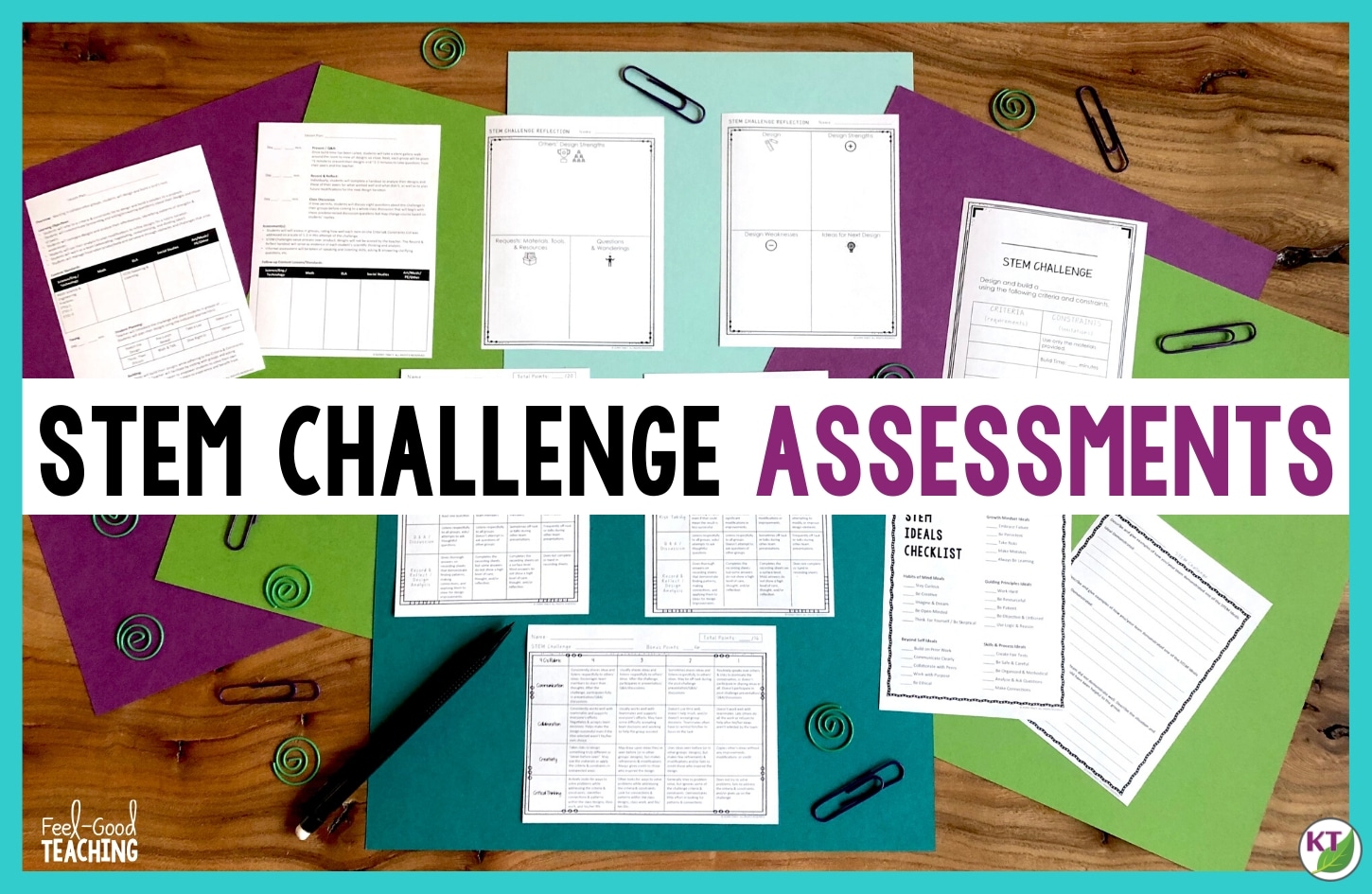
    But after a lot of tinkering and experimenting, I’ve come up with assessment tools I love and can confidently recommend! Read on for some tips, tricks, and tools — including two freebies!


    Why Assess STEM Challenges?

    Many teachers have reached out and explained that grades are required by their administrators to justify time spent on these “fun” activities. Others have expressed an interest in documenting their students’ growth in the engineering design process, but they struggle with how to do that.

    Whatever your reason, you want to make sure your assessments are thoughtfully chosen so they support rather than undermine your overall goals for doing STEM Challenges in the first place.


    What to Assess During STEM Challenges?

    You want to emphasize the skills most important to you — and this could change throughout the year.

    At the beginning of the year, I like to emphasize the 4 C’s of Engineering. I want students to really understand each “C” and what positive and negative examples of each look like.

    As we move further into the year, I shift into a focus on the process steps of the STEM Challenge Cycle (see below). Later in the year, I may switch to a hybrid of the 4 C’s and the STEM Challenge Cycle. I also spend some challenges focusing on STEM Ideals.


    What Not to Assess During STEM Challenges?

    Process over product is my mantra! I never assess students’ designs. Those designs are a vehicle to practice skills and develop scientific thinking. Whether or not the end product is successful is inconsequential compared to how the students analyze those designs and identify features and patterns in successes and failures.


    Assessing the designs is problematic for many reasons. First, it leads to decreased risk-taking and creativity in designs. Your high-achievers will not try a weird idea in their design if they believe taking a safer route will lead to a better grade.


    More importantly, assessing designs impresses upon the students that it’s normal to expect success in one or two tries. In life — and in science especially — this is unrealistic. How many drug trials does it take to arrive upon a cure for a disease? How many times did Edison’s team need to invent a functional light bulb?


    How to Assess STEM Challenges

    So what does this actually look like in practice? I assess in three main areas:


    1. Design Analysis

    With every challenge, each student must complete a written handout for design analysis. This is the “record & reflect” in the STEM Challenge Cycle. If you own any of my challenges, you’ve seen these pages before. If you don’t own one, you can check out this Floating Flower STEM Challenge freebie for an example.


    Flower STEM Challenge
    Floating Flower STEM Challenge


    This is where I can see how my students are developing. I take this as a completion grade. When students don’t show full effort, I return the paper with notes and make re-submitting part of a Must Do / May Do list (it’s a must-do).


    2. Soft Skills

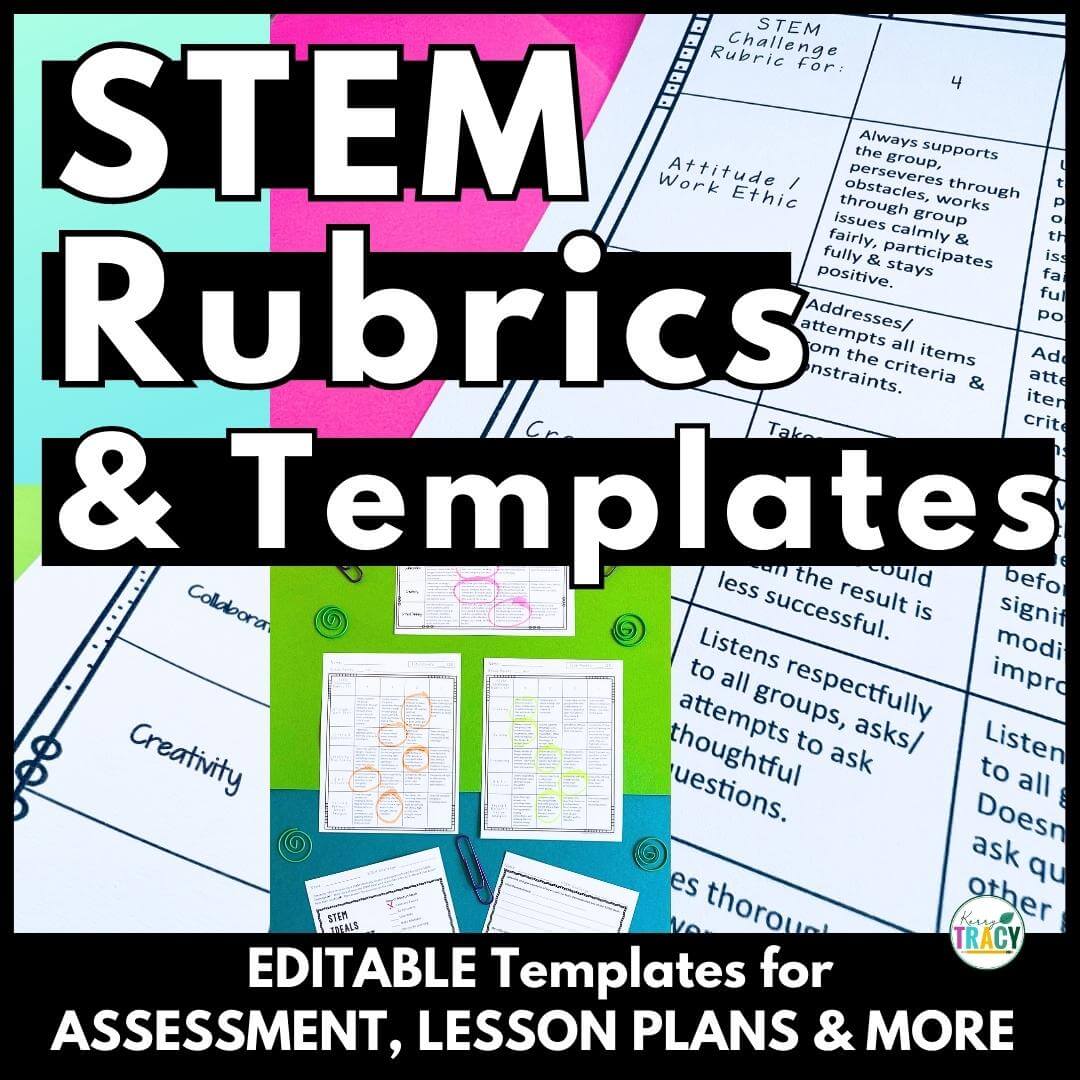
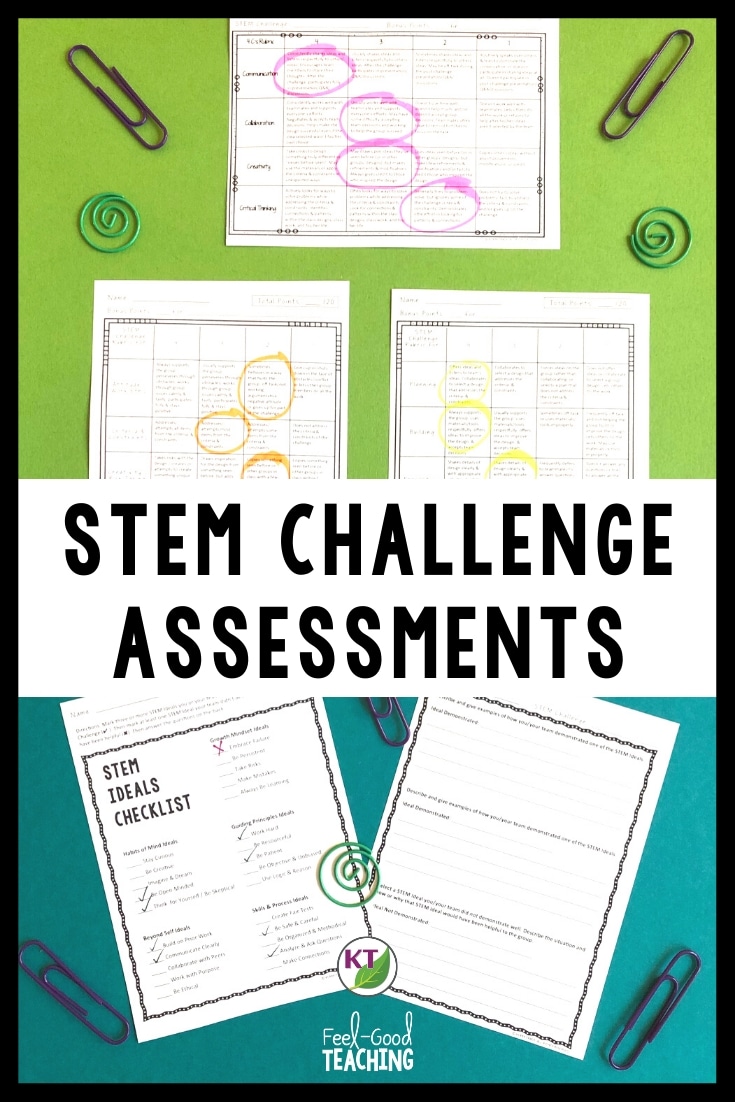
    Rubrics are great for assessing softer skills and for any skill that lends itself well to a continuum. There are four rubrics I use on a consistent basis:

    The 4 C’s

    The STEM Challenge Cycle

    Hybrid: 4 C’s & STEM Challenge Cycle

    STEM Ideals

    You can ask students to self-assess, or you can assess them yourself. I mix it up, and sometimes I do both.


    All four rubrics above are available in print and editable format as part of the STEM Challenge Templates resource.

    Note: You can grab a free print version of my 4 C’s Rubric at the end of this blog post!


    3. Outstanding Participation in Q/A and Discussion

    You know that moment when a student asks another students a deep, thoughtful, or clarifying question that gives you goosebumps and makes you beam with pride? It happens during STEM Challenge share out & Q/A all the time. It’s important to encourage behaviors you like, so I take notes during Q/A on great questions and award bonus points on the rubrics or design analysis handouts for participating so fully in this part of the STEM Challenge Cycle.


    PIN ME!


  • The Problem with Simple STEM

    The Problem with Simple STEM

    Let me start by saying I have nothing inherently against makerspaces, tinker labs, “simple” STEM centers, task cards, and activities. They can be great — in much the same way your favorite breakfast cereal is “part” of a complete breakfast.


    Quick note: There are STEM resources coined as “simple” STEM that refer to the simplicity of the materials needed and/or teacher setup. That isn’t what I’m referring to here.


    The issue is with another kind of “simple” STEM — STEM that is easy. STEM that can be done in a few minutes. STEM that is only a reward for early finishers. STEM that is fun, makes students happy and doesn’t challenge them much or create too much drama.


    Here’s the problem: simple STEM usually doesn’t get to the heart of deep problem-solving. In order to get there, students must work through the engineering design process and practice the 4 C’s of Engineering (communication, collaboration, critical thinking, and creativity). Much of that is missing in most “quick & easy” STEM activities.


    I worry that in our rush to do a little bit of everything, much of what we’re doing doesn’t achieve the intended results. Life is not a sitcom; problems don’t resolve cleanly at the end of 30 minutes. The challenges our kids will face as adults are unfathomable to us now. We need to prepare them to not buckle at the sight of complicated problems, but to push forward with patience and perseverance. They need to have practiced the art of failing and bouncing back. They need experience with analyzing solutions to problems, making changes, and trying again.


    Not to get apocalyptic on you, but … “simple” problem solving ain’t gonna cut it.


    I walked through all of this in a Facebook live session. I’ll embed a replay below. If you’re looking for all the links I mention, head to the Facebook post, YouTube, or TpT.


    And maybe this isn’t resonating with you. A lot depends on how you run your maker spaces and centers, to be sure. And just in case you’re cursing my name wherever you are, let me explain myself with an ELA analogy to take the steam out of this a bit (terrible pun intended).


    Imagine you are teaching your kids how to become writers. You have an eye on that goal and everything that comes with it: completed, developed stories and essays that have structure, creativity, voice, and use the language beautifully.


    Now, imagine the main class activities used to prepare students for this worthy goal are quick writes and free journaling time if/when they finish their other assignments.  What’s the likelihood they develop into competent writers?

     

    Are quick writes themselves bad? No, of course not! Everything is about balance. Quick writes are great when used in conjunction with the writing process and giving and getting feedback. By themselves though, quick writes and journaling won’t give students the tools they need to develop into writers.


    So it makes sense that STEM Challenges and activities work the same way. “Quick & Easy” STEM won’t develop the same skills going through the engineering design process will.


    Let’s reflect on why STEM has become so popular in the first place. It’s because, when done well, it gives students opportunities to build deep critical thinking and problem-solving skills, apply content learning in new situations, and develop grit, perseverance, intellectual stamina, and resilience. These are the reasons STEM is a buzzword and teachers everywhere are being encouraged to bring it into their classrooms.


    Gut check: do you think all those important skills are attainable with 5 – 10 minute “easy” STEM Challenges? Personally, I think it’s about as realistic as expecting those old-timey “exercise” machines to make you tone and fit!


    So it’s important to audit how we’re conducting STEM Challenges and activities in our class. Ask yourself how often your STEM Challenges and activities are:

    • Equitable 
      Do all students get a chance to participate, or must it be “earned” by finishing early?
    • Rigorous
      Are you really challenging your students? Have you set up activities that push your students and could result in failure? (This is what you want to plan to do on a regular basis.) The struggle isn’t the problem — it’s the point!
    • Collaborative
      Students should be working on tough problems with their peers. Collaboration is one of the 4 C’s of Engineering, after all.
    • Discussed, Questioned, and Analyzed
      Are you giving students chances to discuss their designs, ask each other questions, and participate in design analysis? The importance of these steps in developing students’ scientific reasoning & analysis cannot be overstated. They need the time and they need your modeling to achieve this.


    And listen, there’s no judgment here. There’s barely time to brush your hair and teeth in the morning, let alone reflect deeply on your instructional practices on a consistent basis. Don’t toss out what you’re doing, but modify what needs modifying. You can keep your simple STEM, but make sure to make time and space for more robust, deeper types of challenges and activities. If you’re wondering how to implement higher-quality STEM Challenges, check out this free webinar: Secrets to Successful STEM Challenges.


    What are your thoughts? Let me know in the comments what’s going well and what your pain points are when implementing STEM activities in your class.


    Pin Me

    Simple STEM or quick & easy STEM is an attractive idea for teachers, but is it worth your instructional minutes? Maybe … but there are definite problems with “Simple STEM” you should consider before making it part of your classroom. Click through to the blog to learn more.

  • Fail Forward

    Fail Forward

    What could be more important than helping students develop healthy relationships with productive failure? I’m hard-pressed to come up with a single thing, honestly. If we help students learn to look failure square in the face with fearlessness and determination, we will have laid the foundation for a successful life.

    This is why in October 2018, we spent the entire month immersed in Failtober.  We built up in baby steps what to do and how to do it, because the how is the tricky part, right? You can find each week summarized in this post.

    Today, I want to leave you with a few additional resources and tips for cultivating a classroom culture that capitalizes on, and celebrates productive failure!


    Keep Your Growth Mindset Fine-Tuned!

    Before you get to worrying about how your students experience failure, you need to take a look inward. I spent a LOT of my years frozen by my fear of failure. I avoided it at most any cost. This is how I know how crucial it is to give students experiences with failure — and of course the bounce-back — early and often. But in order to do a good job of it, I had to be sure my own actions and words didn’t contradict and undermine what I was aiming to help students believe and do.

    So be sure you examine those thoughts and hold them up to the light of day! And where it is necessary, do a little work on your own mind game. I find I need to do regular check-ups. I’m currently reading Uncertainty: Turning Fear and Doubt into Fuel for Brilliance, for example.

    Podcasts can also be a great pick me up on your drive to/from teaching. I LOVE Teach on, Teach Strong for positive teacher topics. These episodes are especially good for this topic:

    Another thing I have found helpful when I’m experiencing my own resistance or fear of failure is to ask myself how I’d want my students to react if the plight was theirs. Then I do my best to act in kind.

    True story — I once signed up for a series of belly-dancing classes thinking it would be fun. I hated it so much. I could feel how clunky my body moved and knew I must look like a total idiot. I was prepared to never return after the first class (a big deal since I couldn’t get refunded for the series). And then the most annoying thing happened. On the drive home, a daydream of a student frustrated with learning operations with fractions popped into my mind. Would I want her to give up because she didn’t get it and felt dumb trying to do it?  Ugh … no, so I kept going to class. It was the last thing I wanted to do, but that’s precisely why I had to do it. I’d love to give you a success story here about how I became a fantastic dancer; I did not. But, I did try and I got an important reminder of what some of our students experience when they struggle and it made it easier for me to talk the talk because I walked the walk — or poorly danced the dance, as the case may be!


    Keep Your Students’ Growth Mindset Fine-Tuned

    Students also need to expose their feelings about failure to the light of day. So much of our beliefs go unexamined, so we never get a chance to see if they really hold up and align with reality!

    As I showed you in Failtober, I like to use a consistent drip of quotes, stories, and real-life practice on these types of growth mindset skills.

    For my STEM classes, I think it is important to define and explore STEM Ideals, those special ways of thinking and interacting with the world that STEM Pros embody. We do this through imagery, STEM Pro quotes, videos, stories, and class discussions. It’s basically a specific form of character education, and I believe it’s crucial in laying the foundation for developing the characteristics we hope to, including embracing productive failure, along with a host of others.

    You might find that you’d like to add to your work on growth mindset. Tarheelstate Teacher is kind of a classroom community guru, in my opinion. So if you want to add even more character ed. in the form of morning meeting and other activities, check out her Growth Mindset resource (it’s free if you choose to sign up for Tarheelstate Teacher’s newsletter).


    Book Recommendations

    In addition to the resources mentioned above, here are a few books to add to your classroom library. Note: the links below are affiliate links. More details are available on the disclosure page, and you’ll find many of these books available at your local library, so check ’em out and save your cash! 🙂

    Mae Among the Stars

    Ada Byron Lovelace & the Thinking Machine

    Grace Hopper: Queen of Computer Code

    Shark Lady: The True Story of How Eugenie Clark Became the Ocean’s Most Fearless Scientist

    Heroes for My Daughter

    Lives of the Scientists: Experiments, Explosions (and What the Neighbors Thought)

    Super Women: Six Scientists Who Changed the World


    And for parents & teachers, I highly recommend:


    Articles

    And here are a few articles to share with your students:

    8 Successful Products That Only Exist Because of Failure

    48 Famous Failures

    Why the Best Success Stories Often Start with Failure


    Practice Fearless Failure

    Now, this is very clearly the most important step. You need to have your students apply what they’ve learned about failure and growth mindset. This means we need to put ALL students in a position where they will struggle. There are some kids that kind of have this whole school thing nailed! They know how to get straight As and it isn’t even hard for them. I was that kid. It shook my foundation when I finally encountered struggle, well into high school.

    I believe STEM Challenges are a valuable tool for this purpose. You can craft the Criteria & Constraints in such as way as to purposely expose students to struggle and potential failure. Sometimes it happens on its own; sometimes you have to mastermind it.

    Only when students are in those moments of frustration and failure can you determine if any of the growth mindset study has become practice. The importance of the way you manage those moments of failure in the classroom cannot be overstated. I went through some tips on that in the Facebook live embedded below.


    Don’t feel like you’re being mean when you create challenges to elicit failure. It’s perhaps one of the kindest things you can do — giving students a safe place to fail and practice recovering. If it helps, change the objective of the lesson in your mind to practice applying growth mindset skills. It’s easy to believe in resilience, persistence, and determination when you’re doing it in theory. Muscles don’t get stronger by thinking about lifting weights; you actually have to get out there and lift! Students need opportunities to practice and test themselves on these ideals under some pressure, early & often. And who better to provide the opportunities than you?


    Check out the rest of Failtober trainings & resources here.


    PIN Me!

    You know growth mindset is key for your students, but how do you actually get them to adopt a growth mindset? How do you get them to be fearless in the face of failure? How do you get students to embrace productive failure and be determined, persistent and resilient? Click through to the blog for some practical ideas!