Category: Fall

  • Back to School STEM Improv Activity and Freebie

    Back to School STEM Improv Activity and Freebie


    Does it worry you that as students don’t seem to be as creative as they used to? That they struggle mightily when asked to use their imagination?

    My concern over this issue is a big part of why I went back to school for a master’s degree in Design-Based Learning.

    It’s behind the reason I spent the last several years creating STEM Challenge activities, like my Back to School Apple STEM Challenges.

    It’s why I have delivered so much professional development around STEM Challenge best practices.

    And it’s also why I created the STEM Improv series — to help students develop their creativity and imagination. 

    Building creativity is just like everything else; it takes practice to build that muscle to be more reflexive and easier. I am a fan of comedic improv, so I looked to how performers exercise to become more flexible and comfortable diving right into situations with creative abandon and designed a way for students to do the same!


    STEM Improv Video Preview

    Watch the video below for an overview of STEM Improv:


    See original STEM Improv blog post for additional info and a longer walk-through video with examples. 


    Student selected from 3 STEM Categories and drew a design for a fashion item made of socks that catches fish


    How Do We Give Students Practice with Creativity & Imagination?

    So how do we go about helping students retain the playful imagination of their childhoods (or re-engage with it if it seems buried)?

    1. Provide Captivating, Engaging Activities
    2. Give Time & Consistency
    3. Set Realistic Expectations

    Captivating, Engaging Activities to Build Creativity & Imagination

    Luckily, there are many quick creativity-building activities you can add to your class that don’t require much time or prep. I’ve always enjoyed the one where you come up with as many different uses for a _______ (brick, paperclip, etc.) in a set amount of time. That’s a great one to throw in when you finish a lesson a few minutes early.

    But today, I want to focus on a resource I created (and you can try it for free!) with these goals in mind:

    • help students build their creativity, problem-solving & flexibility muscles
    • can be done in 15 minutes or less
    • virtually no prep

    The format is simple: 

    1. Students spin a wheel (or pull a printed card) to randomly select from three categories:

    • Object
    • Material*
    • Function

    *The materials lists include some unconventional building materials (like crayons!) resulting in whimsical, often hilarious, designs like the one below. Because students are planning but not actually build prototypes for their designs (unless you choose to extend), you do not need to provide materials to students.

    2. Next they create a design plan & answer questions about their initial plan.

    3. If there is extra time, sharing designs, discussions & extensions are optional. (Kids love the chance to share, so it’s a good idea to make some time at least once a week to share out their favorite recent design ideas.)


    Example from Back to School STEM Improve Activity Freebie – 336 possible combinations!


    Time & Consistency

    This one is pretty straight-forward: if we say creativity & imagination are important, we must treat them as such. Fortunately, this doesn’t have to take a lot of time at all. The STEM Improv exercises only need 10-15 minutes, with the occasional sharing time or other extensions added in where you can make it fit. It can be done during morning work, choice boards, sub days, centers, Makerspace, etc.

    The beauty of STEM Improv is that each individual set has 336 unique combinations, so you can use it for quite awhile with incredibly little setup time. I’d recommend doing this activity with your class at least weekly, but as students start building their creativity, they’ll ask for more than that!

    Review left by a 6th grade teacher for STEM Improv Set 3


    Realistic Expectations

    I’ve been guilty in the past of asking students to be creative & use their imaginations when writing a story or creating a STEM Challenge design. Here’s the thing: while it comes naturally for some students, others don’t really know how to do that or what it means.

    I don’t know about you, but when I’m asked to do something and my brain doesn’t cooperate, one of my first reactions is embarrassment. I’m thinking, “My brain doesn’t do what everyone else’s brain does. Am I dumb?”

    And all that self-doubt and embarrassment doesn’t exactly provide the fertile ground needed for new ideas! 😂

    It’s important that we set up an environment in which we are honest that sometimes it can be hard to be creative. Even the best writers get writer’s block. Not all of our ideas will be winners every time, and when we put that pressure on ourselves we’re making it harder to feel the ease and get into the flow of generating ideas. So give students LOTS of chances to practice being creative without judgment about the quality of their ideas. Some ideas are winners, some are flops, and the most important thing is that we practice coming up with ideas in the first place.

    This is why I love the STEM Improv activity so much — it’s about the practice, the lifting mental weights rather than the outcome. And it doesn’t hurt that it’s a ton of fun for all ages!


    Review left by a parent of a kindergartener & 4th grader for STEM Improv Set 3


    Review left by 6th & 7th grade teacher for STEM Improv Set 1


    Review left by 3rd grade teacher for STEM Improv Set 1


    What else are teachers saying about these Quick STEM Activities?

    “I did this activity with my 3rd and 4th grade Gifted and Talented classes! They loved it!! It was definitely a change for them in that “all” they were doing was designing, they are accustomed to creating. But this was really good for them to focus on the design. My students who struggle with being creative and seeing outside the norm definitely struggled with this. I liked your suggestion in the material to help a student think about just 2 components and that helped them start. I know I will use this over and over again. Thank you!”

    – Kerry S. (Comment left in YouTube comments)


    “I tried out STEM improv with one of my 4th grade classes today, and they loved it.  They asked when then can do this again and if they can have sets of cards to take home.  It was the perfect activity because I was missing about 1/3 of the students.”

    – Rachel F. (Comment sent via email)


    See all the STEM Improv Sets

    If you have any questions, visit the Q/A tab on TpT and let me know! 🙂

    All the seasonal and regular STEM Improv Activities can be found in my Teachers Pay Teachers shop.


    Looking for More Back to School STEM?

    Check out these related posts:


    Pin Me

  • Back to School STEM Modified for Distance Learning

    Back to School STEM Modified for Distance Learning

    Back to School STEM Challenges are among my favorites, so this pandemic had me extra cranky thinking about yet another thing ruined by the changes this year.

    I figured out a little mind game to play with myself though that I think might save the day when it comes to Back to School STEM: when I let go of what it was and what I wanted it to be, I was able to free up my mind to reimagine what it could be now.

    I did a live stream recently where I talked through some of the modifications for one of my favorite fall STEM Challenges: Apples A-head. I consider both social distancing and distance learning. I’ll sum up the ideas underneath the video, so take your pick of how you like your content delivered!


    What Apples A-head Was

    In Apples A-head, students create a device to help them balance an apple on their heads, which they test by participating in a relay race. It’s a fabulous challenge for the end of the first week of school. Teachers get to see how students think, problem-solve, and work collaboratively.

    A part of this challenge still works in distancing environments: because I was always concerned about head lice, in this challenge, each student creates his/her own head gear. The collaboration piece can come in several forms:

    • teams can create one design that each student builds
    • teams can create unique designs, but include a unifying team element
    • teams give each other feedback on unique designs
    • teams choose a team name
    • teams participate in the relay race together


    Here’s a video walk-through of the challenge, the way it was:


    Not all of that works with our new normal, so let’s talk about changes needed.


    What Apples A-head Can Be

    We have to consider issues with getting materials, especially for those learning from home. We also need to address the relay race piece.

    Materials

    I always aim to use simple and cheap materials, but that doesn’t mean I can expect families to have it all on hand. And not everything you see above is strictly required for the challenge anyway.

    One of the mind shifts I have made is in recognizing things as lessons and teachable moments I might not have considered before. In the case of materials, I might make an entire lesson around having students consider the suggested materials list and look around their homes for substitutions. Think about the comparing & contrasting and consideration of properties that students do in this case.

    This also gives me an opportunity to introduce one of my favorite STEM Ideals: Be resourceful. I love the idea of training students early on to be resourceful and work around perceived obstacles. It’s so empowering!

    In the video at the top of this post, I go through examples of materials substitutions starting at about the 8 minute mark.

    Collaboration & the Relay Race

    Ms. Yonemura Apples A-head STEM Relay 2

    Most of the collaboration options listed in what Apples A-head was apply in social distance and distance learning environments, but the relay race piece is tricky! Can that work? What adjustments can we make and still have it be joyful?!

    Relay Race Options in Social Distance (SD) & Distance Learning (DL) Environments:

    First, you know you don’t have to solve all the problems yourself, right?! Involve your students! Put them in teams (breakout rooms or shared slides work well with DL) and lay out how the relay race used to be implemented to test designs.

    Lay it out as criteria & constraints.

    Criteria examples:

    • We need an active way to test designs
    • Designs should be tested in teams
    • Tests should be fun or silly
    • Tests should be fair

    Constraints examples:

    • no shared materials
    • students can’t be within 6 feet of each other
    • students are at home on Zoom

    In teams, have students brainstorm and recommend relay race alternatives or modifications. In the video at the top of this post, I talk through some ideas at about the 20 minute mark.


    This Can Work

    What this exercise taught me is the importance of letting go of my notion of how something should be in order to free up what it can become. It’s very similar to when we see kids struggling with immense frustration and emotional investment in a design that isn’t working. Sometimes it’s good to keep trying, and sometimes when you let it go, you’ll find another way that has its own advantages. What I want isn’t an option right now, but there are opportunities in what is … if I can get out of my way long enough to discover them.


    Apples A-head STEM Challenge Paperless Resource Cover

    Apples A-Head Print Resource Cover


  • Thanksgiving STEM Challenge – Pumpkin Picker

    Thanksgiving STEM Challenge – Pumpkin Picker

    When any group of people settle in a new land like the Pilgrims did, one of the first areas of concern is to gather food. The Pumpkin Picker STEM Challenge is a fantastic way to bring a little history and real-world problem-solving to your classroom for the holiday!


    What’s this STEM Challenge About?

    Pumpkin Picker is about harvesting pumpkins as efficiently as possible! There are lots of ways to modify the challenge to make it easier or tougher for a variety of ages!


    How to Implement this STEM Challenge

    It’s easier for me to show you some of your options, so I recorded this short video 👇:


    Materials Needed:

    Materials you’ll need to do the activity are easily modified. Amazon Affiliate links are included below.

    • Candy pumpkins or candy corn (24 – 36) (Rolos or wrapped caramels can be substituted)
    • Pipe cleaners (5 – 10)
    • Popsicle/craft sticks (10 – 15)
    • Plastic spoons (5 – 10)
    • Bowl or holding container for harvested pumpkins
    • Scissors
    • Copies of pumpkin patch guide handout (included in resource) or green construction paper

    Optional:


    Content Connections:

    • Multiplication and arrays
    • Life in the New World
    • Anything related to plants (plant parts, plant needs, life cycles, photosynthesis, etc.)

    For more content connections, check out the video above and the resources below.


    What Are Teachers Saying About Pumpkin Picker?

    “This is a fun STEM challenge that is very thought provoking. Excellent tie in to writing and math, and very detailed teacher notes and steps. That makes it so much easier to get everything set up so the students can start learning. Great product! Thank you!”

    “Perfect for my little engineers!”


    “I used this with my 8th grade STEM class and they had such an amazing time. I couldn’t find any pumpkin candies or candy corn in stores (even though it wasn’t even Thanksgiving yet) so I used caramels instead. It worked like a charm because they are about the same size and consistency. I will be using this again!”


    “So many ways to enhance and stretch this fun project. My 7th graders had a blast.”

    “We use this resource every year before Thanksgiving break”


    “What a fun challenge for my students! Some of them were confident in the beginning and then realized it was a bit more difficult than they thought and had to adjust their designs. I also appreciated all of the additional activities included which could allow someone to turn this into a week-long unit.”


    “My students loved this activity! All of their products created were very different.”


    See the Resources:

    Thanksgiving resources are available on the STEM Challenge site and on Teachers Pay Teachers.


    Go to the Thanksgiving STEM Challenge Resources Hub


    Thanksgiving STEM Challenge Activities


    Pin Me

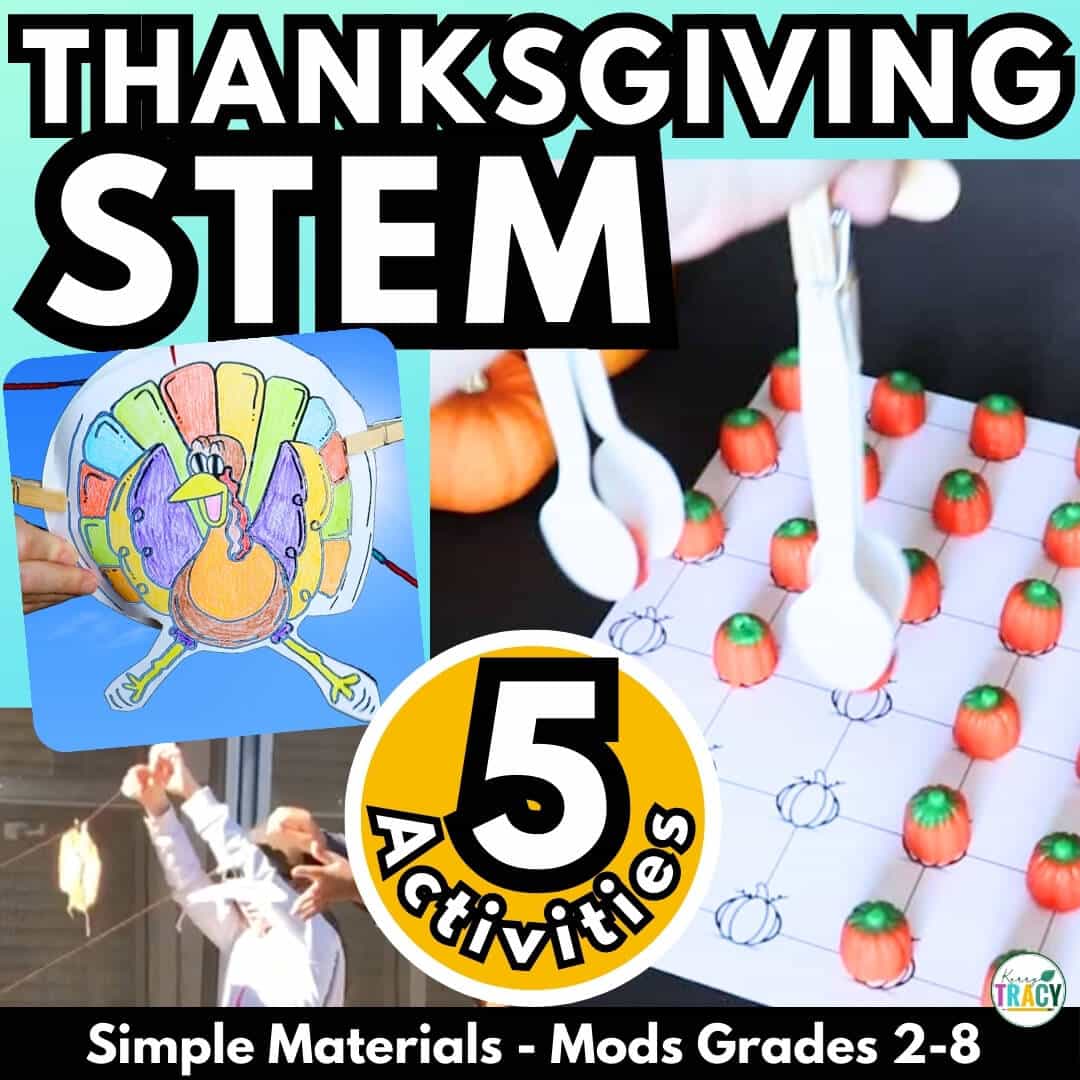
    Pumpkin Picker is the perfect Thanksgiving STEM Challenge activity to keep your kids engaged during the holidays. It’s full of rigor, engagement, and fun with modifications for grades 2-8. Click through to the blog to see more details, including a video walk-through!

  • Halloween STEM Challenge – Bone Bridge

    Halloween STEM Challenge – Bone Bridge

    The Bone Bridge STEM Challenge is a perfect fit for your Halloween activities because it’s fun with substance! In this challenge, students build a bridge for length, strength, and/or capacity using cotton swab “bones”.

    Not doing Halloween activities? Bone Bridge® also works well with studies of the skeletal system, bridges and transportation, forces, or physical properties. Read on and watch the video for materials, implementation tips, and content connections.


    How to Implement the Challenge


    Watch the video walkthrough for materials, criteria and constraints, ways to measure results, modifications, and cross-curricular extensions.


    Materials Needed

    Sample/suggested materials for each student or group:

    Materials you’ll need to do the activity are easily modified. Amazon Affiliate links are included below.

    Optional:

    • Straws

    • String

    • Cardboard

    • Tape, cable ties

    • Candy pumpkins or base-ten blocks for weights (if weight/capacity criterion is used)


    How the Bone Bridge STEM Challenge Works

    Students use the available materials to design and build a bridge that meets the criteria and constraints you choose. Depending on your learning goals and students’ ages, you can test the bridges for length, strength, capacity, or a combination of all three.

    Students develop their own solutions, test their bridges, and use the results to make improvements rather than following a model or step-by-step building directions.

    Content Connections

    The skeleton bridge theme makes it easy to connect this STEM challenge to several science and engineering topics:

    • Skeletal system
    • Bridges & transportation
    • Forces
    • Physical properties

    For additional cross-curricular content connections, check the video at the top of the post.


    Want the ready-to-use version?

     Get the complete Bone Bridge® STEM Challenge with teacher tips, student handouts, criteria and constraints, modifications, extensions, and more.

    You can get Bone Bridge® individually or as part of the Halloween STEM Challenge Bundle.


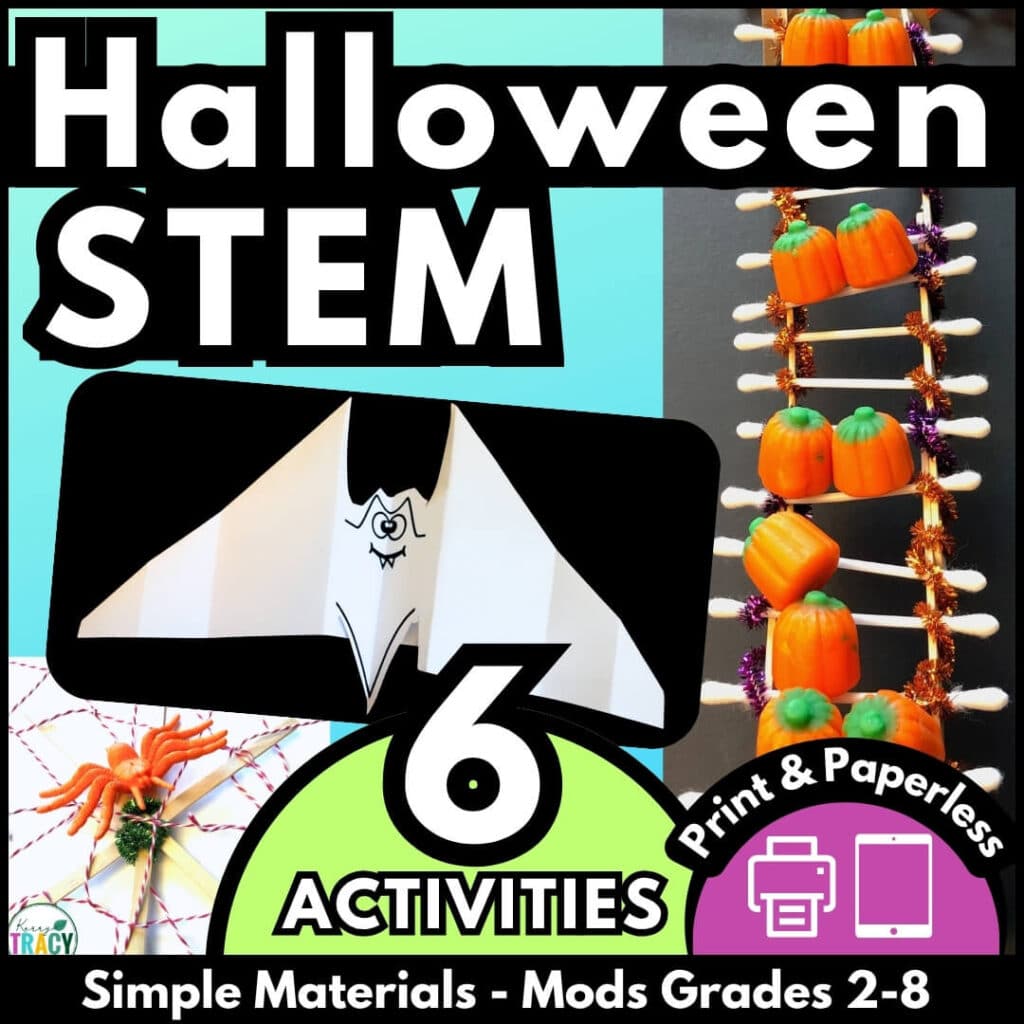
    6 Halloween STEM Activities including Bone Bridge, Spider Web, and Bat Wings Paper Airplane


    Explore More Halloween STEM Challenges

    Halloween STEM Challenge Activities


    PIN ME


  • Apple Annihilator Fall STEM Challenge

    Apple Annihilator Fall STEM Challenge

    Got apples and some common school supplies? A great way to put them to good use is with the Apple Annihilator STEM Challenge. Students will use their materials to build a wrecking ball designed for accuracy or total annihilation! They’ll test  their designs by setting up marker “bowling pins” and try to knock down as many as possible using their apple wrecking ball designs.


    Apple Annihilator STEM Challenge is perfect for first day of school, team-building, fall and apple day activities and for learning about forces and motion. Click through to the blog to learn more.


    What’s extra awesome is a very similar set of materials is used in all five Back-to-School STEM Challenges, so you can try them all!


    How to Implement the Challenge


    Check out this video walk-through of the challenge to see the materials, criteria & constraints, measuring results, cross-curricular extensions and more:


    Materials Needed

    Sample/suggested materials for each student or group:

    Materials you’ll need to do the activity are easily modified. Amazon Affiliate links are included below.

    Optional

    • Cardboard boxes, tubes, or scraps

    • helpful in building a support structure and base for the wrecking ball rather than attaching to desk/table)

    • Craft sticks

    • Pipe cleaners

    • Dowels


    Content Connections

    Apple Annihilator is a great intro to Newton’s Third Law of Motion, which is part of 3rd and middle school NGSS standards! (3PS2-1, MS-PS2-1, and MS-PS2-2).

    It can also be used to illustrate potential & kinetic energy, forces & motion. For additional cross-curricular content connections, check the video at the top of the post.


    See the Resource

    Fall STEM Challenge resources are available on STEMChallenge.com and on Teachers Pay Teachers.


    Apple Annihilator Print Resource Cover

    Apple Annihilator Paperless Resource Cover


    Back to School STEM Challenge Bundle Cover

    BTS STEM Bundle Paperless Cover


    Go to the Back-to-School STEM Challenge Resources Hub

    Back to School STEM Activities

    Grab The 4 C’s of Engineering Freebie


    Pin Me!

    Apple Annihilator STEM Challenge is perfect for back to school activities, team-building, fall activities and for learning about Newton's laws of motion in action. Click through to the blog to learn more.


  • 7 Back-to-School STEM Must-Haves

    7 Back-to-School STEM Must-Haves

    When you go back to school this fall, you’re going to want to have your STEM game sitting pretty. Luckily, you’ve just stumbled on seven back-to-school STEM must haves — and five of them are free! Even if you’re seeing this at another time of year, most of these are year-round must-haves!


    Fill in this form to grab all the freebies at once, or pick and choose the ones you want using the links in each section below instead!


    1) The 4 C’s

    The 4 C’s are a guiding force in engineering: collaboration, communication, creativity, and critical thinking. These 4 C’s set the foundation for all your STEM activities and challenges throughout the year, so it makes sense to devote some time & space to them in your class at the beginning of the year. These free posters & activity will get you started on the right foot!


    2) A Mission

    Do you ever get so flippin’ tired and stressed out that you forget why you ever wanted to teach in the first place? Before you go back to school this fall, take a quick minute to reflect and prioritize your goals. It’s a small thing, but grounding yourself in this way can help stave off burn out.


    Pick up the free classroom mission statement template.


    3) An Ice Breaker

    Confession time: I hate ice-breakers. OMG, I hate them so, so much! Nothing is worse than sitting down in your first in-service and getting the dreaded Bingo board! ?


    Yet with our students, we really do want to break the ice and make our students as comfortable as possible as quickly as possible…


    So … ice breakers … right?


    Consider the fact that a LOT of students have done a spaghetti and marshmallow tower or Saving Sam/Fred as many times as you’ve done that flippin’ Bingo Board activity.


    And I’m not saying those are bad activities, just that you might want to freshen up the materials and/or the criteria & constraints to better match your students’ age/ability/ grade-level standards. Make what’s old, new again.


    Or you might consider something less likely to have been done before to send the message to your students that your classroom is a place they’re going to be stretched to discover new things about the world and themselves! ?


    If you’re looking for something a little off the beaten path, check out these Back-to-School STEM Challenges on YouTube. Resources are linked in each video description. You can also find more details on the Back-to-School STEM Challenge Hub Page.


    I love all my challenges like children, but Apples A-head is probably my favorite of this bunch for its beautiful combination of STEM, PE, team-building and flat-out fun (not fluff)!


    All the challenges in this set are perfect places to tie in extensions on measurement, forces, Newton’s Laws of Motion, writing, and more!


    4) STEM Materials Parent Donation Letter

    If you’re going to be making STEM Challenges a regular part of your class, you’re going to need help getting materials. You might be surprised at what parents will donate when you ask and make it easy for them! Check out this editable parent letter to request donations. There’s also a video inside to help you set up an Amazon wish list. You never know if you don’t ask!

    Pick up the free starter pack with editable parent donation letter.


    5) STEM Ideals

    For a loooooong time, I’ve been looking for some way to help my students understand what it means to think like scientists. Of course, all the hands-on labs, inquiry, and STEM Challenges are absolutely critical to achieving this goal, but I noticed it wasn’t getting the job done for a lot of students.


    I finally realized that I was hoping they’d latch on to what I call STEM Ideals through osmosis. I’m not sure why I thought that would work! I finally put together a series of STEM Ideals posters & activities to explicitly & intentionally study the way STEM Pros relate to their work and the world.


    Pick up Set 3 for free!


    6) Universal STEM Challenge Templates

    You might also be interested in these universal lesson plans, assessment rubrics, and record & reflect pages. Set the tone right away that you value process over product by using assessment pieces that align with your goals instead of undermining them!


    Check out the Universal STEM Challenge Templates.


    7) STEM Challenge PD

    Need a little more inspiration? Want to make sure you’re implementing STEM Challenges in a way that reaps all the benefits and isn’t just surface-level fun? Have you seen the free Secrets to Successful STEM Challenges Webinar? It’s free and chock-full of valuable information to help you get the most from every STEM Challenge you implement!


    PIN ME

  • Get to Know Your Students with the 4 C’s of Engineering

    Get to Know Your Students with the 4 C’s of Engineering

    The 4 C’s of Engineering are collaboration, communication, creativity and critical thinking. They should be at the foundation of every successful STEM Challenge you facilitate with your students, and what better way to start the school year than by emphasizing the importance of all four?!

    Back to School STEM Activities


    Back-to-School STEM Challenges are my favorite ice breaker because it’s about so much more than students getting to know each other. It gives you a chance to practice your procedures and class rules. You’ll be covering content standards, of course. But the real draw for me is how much you’ll learn in such a short time about how your kids think, how well they work in teams, and where you’ll need to spend some time helping them develop those 4 C’s. I’ve prepared these 4 C’s posters with an activity that you can grab for free to get you on your way below!


    If you’re looking for Back-to-School STEM Challenges that are a little more original and that your students are less likely to have #beenthere #donethat, check these out! My personal favorites are Apples A-head and Apple Annihilator, but you really can’t go wrong with any option!


    Find More Back-to-School Relationship Building Activities linked below the image!


    Click through to find more Back-to-School activities and freebies to help build relationships from the first day of school!


    Building Personal Relationships with Your Students on the First Day of School // Samson’s Shoppe


    How to Get to Know Your Students as Workers and Partners – Think Grow Giggle


    Learn Your Students’ Names on the First Day of School // Reading by Heart


    First Day of School Relationships // Mikey D Teach


    Get to Know Your Students with the 4 C’s of Engineering // Kerry Tracy

  • Thanksgiving STEM Challenge Activity: Turkey Transporter

    Thanksgiving STEM Challenge Activity: Turkey Transporter

    I recently had a fantastic time visiting Tried & True Teaching Tools‘ 4th grade classroom to do the Turkey Transporter Thanksgiving STEM Challenge. They came up with such great ideas and did a fantastic job of analyzing their designs. We even had time for two rounds of testing. I’ll be honest — I am pretty much the worst with keeping to my STEM Challenge timings!

    I’m always solid with the planning and building, but once we get to the sharing of designs, testing, and discussion … all bets are off! And you know what? Sorry, not sorry! This is the golden stuff! This is where students are analyzing, making connections, building up their growth mindset skills — so I’m not likely to cut short some of the most valuable critical thinking and problem solving just because the clock says so! Teachers know that flexibility is important to capitalize on those magical, feel-good teaching moments, so that’s just what I prepare to do before a STEM Challenge.


    Turkey Transporter STEM Challenge

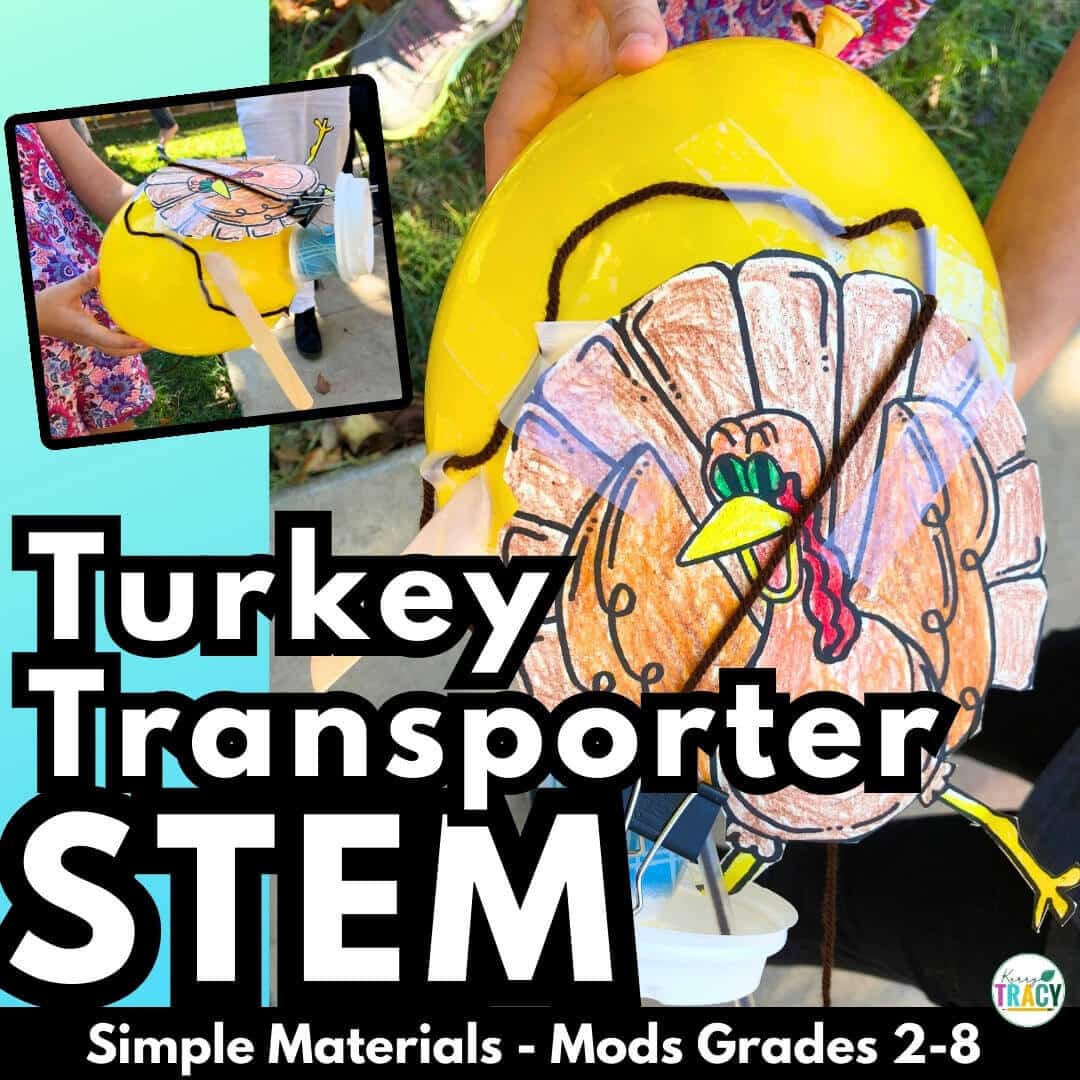
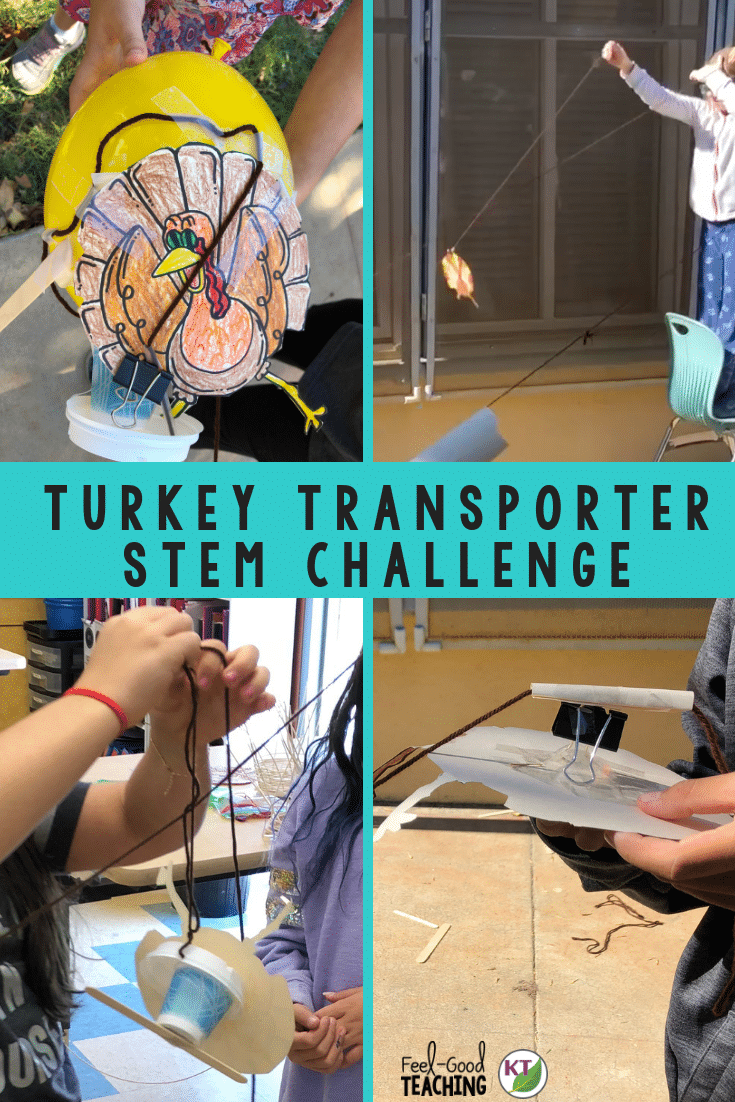
    In this STEM Challenge, students have to design something to get a turkey safely from point A to point B. There are two options: horizontal or vertical distance. For this lesson, we chose to transport over a horizontal distance, but you can always do both to up the difficulty level, if you like.

    In the horizontal test, the goal is to transport the turkey as quickly and safely as possible. In the vertical test, the goal is the slowest, safest drop.

    Here’s a walk-through of the overall lesson with options to modify difficulty included:


    The STEM Challenge Cycle

    For any STEM Challenge, I have a standard format I tend to follow, but the time allotted for each section is variable. The video below shows the rough break down of a typical STEM Challenge lesson.


    Different challenges do call for different amounts of time for the build and testing. Turkey Transporter is one that requires a little more testing time, especially if you want to provide students multiple tries at testing and/or time to modify designs after round 1.


     My Turkey Transporter plan in this 4th grade class was as follows:

    10 minutes: Intro myself and the challenge Criteria & Constraints List & distribute materials

    25 minutes: Planning & build time (circulate & observe; answer clarifying questions)

    Thanksgiving STEM Challenge: In Turkey Transporter, students design a way to transport turkeys quickly and safely across a horizontal and/or vertical distance. Includes modifications grades 2 - 8. Click through to the blog to see examples and video of student designs.
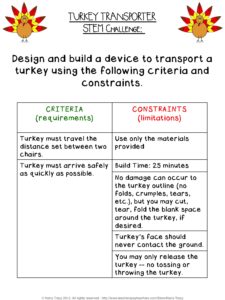
    Turkey Transporter Criteria and Constraints List

    20 minutes: Share out designs and testing (Students briefly describe why they designed what they did, e.g. were they going . for light-weight designs, aerodynamics, adding weight, etc. Then they test!)

    15 minutes: Whole-class discussion (I start with with base of 8 questions, but always add specific questions based on my observations throughout the challenge).

    15 minutes: Begin the record & reflect handouts

    Total time: One hour, 25 minutes (with extensions and other iterations to be considered for the following class periods).

    … but here’s what actually happened!

    5 minutes: Intro

    I knew I needed to save as much time as I could where I could, so I quickly got through the intro and answered students’ clarifying questions about the Criteria & Constraints list. Students were put into groups of 4 and materials were distributed.

    25 minutes: Plan & Build

    As I said, this part isn’t too hard to stick to. I didn’t give students a defined time for planning vs. building, we just jumped right into it. I circulated and observed during this time. I also called out occasionally to let them know how much time they had left.

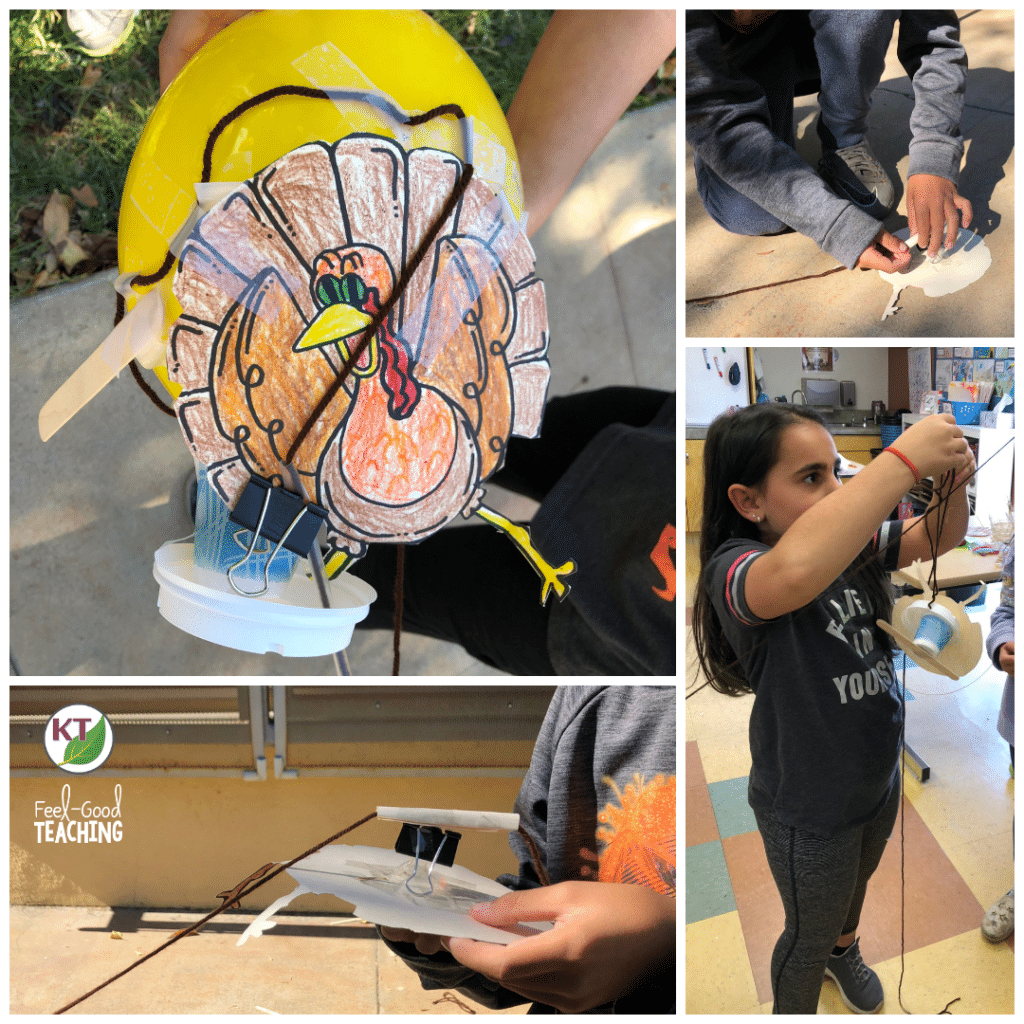
    While I was circulating, some students asked clarifying questions. I usually referred them back to the Criteria & Constraints List. If they’ve found a loophole in the list I provided, I consider that a big win. In this case, a couple of groups rolled their turkeys (see examples in the testing videos further down). The Criteria & Constraints list says no damage can occur – no folds, not tears, no crumples. But rolling it, while it could be argued results in damage, it can also be argued it does not. I allowed it.

    In the future, I might consider changing the constraint to include that the turkey template must maintain its flat shape after it is transported. But, to be honest, I might not change it at all. It worked well, but there were plenty of other great designs too!

    During the regular build time, groups were performing their own tests and tweaking their designs.

    35 minutes: Let the Official Testing Begin!

    OK, here’s where I got off-track (#noregrets). We set up three testing stations. I recorded the testing on my phone so we could validate the timing, if there was a dispute. Before the test, the groups describe their designs and thinking behind it. Don’t skip this step! It’s important for students to describe their reasoning, and to hear that of their peers. Some of the best discussion questions and topics are inspired by this!  In our case, some groups were trying to make their designs very light, while others were going for heavier designs. This set up a great discussion, and a potential science experiment/investigation for later!


    Then, it was time to release! I included the first round of testing below:


    After round 1, I could have chosen to stick to my original schedule. I was actually right on track at that point. But, here’s the thing … the students were deeply engaged and dying to have another go at testing. We decided to trade out the yarn for fishing line to see if that would make a difference (spoiler alert: it did, and now we opened up an opportunity to learn about friction!).

    So, yeah, I gave the students more time to tweak designs and re-test. This gobbled up (pun intended) an extra 15 minutes I hadn’t planned for.


    15 minutes: Whole-Class Discussion

    I kept to this part of the schedule mostly because lunch stopped us! I have a standard set of questions as my foundation (see more on post challenge discussions here). In addition to those questions, we discussed two burning topics from the day: what to do when people copy your designs and what to do when your design fails or is ineffective.

    Students naturally hate when their designs are copied. Frankly, I don’t know that we ever get over this. When someone copies my work, it throws me into a tailspin. One thing I do when this comes up is to validate the hard feelings that come along with it. The other point I try to make is to encourage students to give credit when they’re inspired by others’ designs. This small step does two things: 1) It helps the original creators feel better because they are getting the credit for being the first. 2) It helps all students understand the importance of crediting in general. This is helpful down the line when teaching about plagiarism and citing sources.

    We also analyzed what worked well overall, what was tried, and what what factors impacted success. Importantly, we discussed keeping a cool head when designs don’t work out as planned. It’s important to me that students understand that it’s for sure more fun when our designs work, but it’s also not expected. In life, and especially in STEM, a lot of trial and error is the norm. What we’re looking for in any iteration is to learn something. You can do that from a design whether it’s successful or not. We also discussed that simply because a design doesn’t perform on the first try doesn’t mean it doesn’t have potential or merit. It’s often a small change that can turn everything around.

    What We Missed!

    So, we ran out of time to complete the record & reflect handouts. This isn’t the first time for me. Sometimes I give these as homework, or I put it on a “Must-Do” list for students for later that day or the next. I never skip it entirely; it’s the heart of the analysis piece! I go over more about the why and how of post-challenge activities in this post.

    My STEM Challenge Advice

    My advice to teachers is to not fear when challenges don’t go as planned. Be prepared to help students analyze and deal with the emotions that come with things not going to plan. I always say that you want to set up your challenges so that they’re actually challenging, not just fun. Fun is fabulous — but you want it to be fun with substance. Failed designs shouldn’t be feared! They should be welcomed! You can often find that if you take advantage, failed designs result in even better learning opportunities than successful ones. You just have to be prepared to jump on those opportunities to dive deep into analysis and work on those growth mindset skills.

    Check out this post (especially the practice fearless failure section) if you want to know more about taking advantage of epic STEM Challenge fails!

    Video resources:

    All Students Deserve to Fail

    Stop Making These Common STEM Challenge Mistakes


    See More Thanksgiving

    Thanksgiving STEM Challenges Hub Page

    PIN ME, DON’T FORGET ME!

    Thanksgiving STEM Challenge: In Turkey Transporter, students design a way to transport turkeys quickly and safely across a horizontal and/or vertical distance. Includes modifications grades 2 - 8. Click through to the blog to see examples and video of student designs.

  • What’s Your Biggest Fear? (#Failtober)

    What’s Your Biggest Fear? (#Failtober)

    What really gets your heart beating faster, palms sweaty, and mouth dry with debilitating fright?

    Spiders? Heights? Rats? Ghosts?

    For too many people, the fear of failure is the most terrifying of all! What’s worse, the fear of failure can create a hugely detrimental effect on people’s lives, but it doesn’t have to. Most fears dissipate upon closer examination, and failure is no exception to the rule.

    So in honor of the spookiest month, I hereby declare October, Failtober! Join me in spending October exploring failure and examining how crucial it actually is to success, and how we can help our students become more comfortable with productive failure early on. If we can help them form healthy relationships with failure, it may be the most precious gift we ever give them!

    There are daily and weekly items planned, freebies and resources to be given, and more! Check out what’s coming below!


    Daily Failtober Quotes

    I’ll be releasing a daily inspirational failure quote on Facebook and Instagram. In fact, I had trouble narrowing the list to 31, so I’m starting a little early with the quotes. Note: Newsletter subscribers have access to the printable/presentation versions of the quotes, so you can easily share these quotes with your students. If you’re not a subscriber yet, you can sign up and receive the quotes as a thank-you gift below.

    Create a bulletin board display with the quotes and/or use them as conversation starters or quick writes. We’ll discuss other ideas in the first #Failtober Live session!


    Sign up for the newsletter and receive the print/presentable PDF version of inspirational failure quotes.


    Weekly Failtober Video Sessions

    In addition to the daily quotes, there are weekly videos with ideas you can focus on with your class to develop a more healthy relationship with failure.

    You’ll find each week’s videos embedded in the post below.

    Week 1: Launching of Failtober!

    Week 2: STEM Ideals = Life Ideals

    Week 3: Halloween STEM Challenges

    Week 4: How to Handle Epic STEM Challenge Failures

    Week 5: Accidents, Mistakes, & Fabulous Failures


    Week 1: Launching of Failtober!

    We’ll discuss what to expect this month, ways to use the quotes, and clarifying the difference between glorifying abject failure vs. productive failure!


    Week 2: STEM Ideals = Life Ideals

    I’ve been thinking a lot lately about what I consider to be STEM Ideals (i.e. traits or habits), and the ability to form a healthy relationship with failure may be the chief among them. I’ve been working on a list of 25 STEM Ideals grouped into five categories: Growth Mindset, Skills & Process, Guiding Principles, Habits of Mind, and Beyond Self. Because I feel so strongly that conquering the fear of failure leads to limitless success, we’re dedicating the entire month to this key ideal. During this live, we’ll make connections between this and other STEM Ideals and how they truly are life ideals. I’ll show you some ways to use these ideals with your students and tell you how to get your hands on related resources!


    Note: The Growth Mindset flash freebie has expired, but the Guiding Principles set of STEM Ideals is available for free. 


    Week 3: Halloween STEM Challenges

    You knew I couldn’t cover a month on productive failure without using STEM Challenges as a fabulous classroom tool to help students develop their resilience, persistence, and stamina in the face of frustration and failure! This week, we’ll go over five Halloween STEM Challenges (and ways to make them non-Halloween if your school won’t allow it). I’ll connect you to the resources, video walk-throughs, and rank the challenges in order of ease of implementation.


    Find the Halloween STEM Challenges here.


    Week 4: How to Handle Epic STEM Challenge Failures

    The perfect follow-up for Halloween STEM Challenges is how to handle an epic STEM Challenge failure (minor ones too) with your students so you don’t inadvertently promote unhealthy reactions to failure. This might be the most important week to tune in, so mark your calendar!


    See more resources to walk your students through exactly how to persevere and keep going through an epic fail.


    Week 5: Accidents, Mistakes, and Fabulous Failures

    I’ll recap the key points of Failtober and I’ll give you some resource ideas (books, podcasts, articles, etc.) of how to use these with your students, why it’s important, and ways to continue exploring productive failure with your class.


    Here’s the Fail Forward blog post I mentioned in the video.


    Pin Me! Don’t Forget Me! 

    One of the trickiest and scariest problems teachers face is helping students overcome the fear of failure with growth mindset traits like resilience, grit, persistence and determination. The fear of failure can so adversely affect our students lives that I'm devoting a whole month to it -- the scariest month of the year -- Failtober! Click through to the blog to see what's in store!